
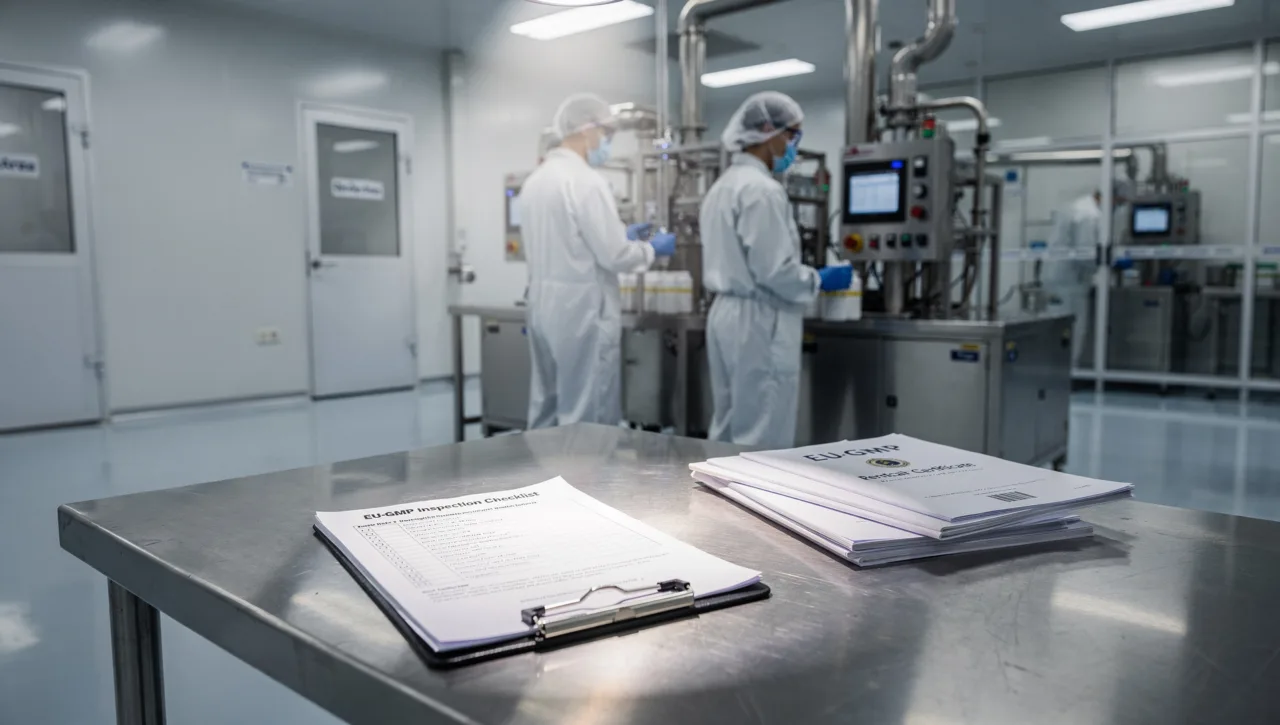
Sterile Product Manufacturing Under EU GMP Annex 1:
Sterile product manufacturing represents one of the most regulated and risk-critical activities within the pharmaceutical and biotechnology industries. EU GMP Annex 1 (2022 revision) has significantly raised expectations around contamination control, cleanroom design, aseptic processing, personnel practices, and sterilization validation.
This article provides a structured, practical overview of sterile manufacturing requirements under EU GMP Annex 1, covering cleanroom classifications, aseptic processing, sterilization methods, and personnel controls—key knowledge areas for GMP professionals, quality leaders, and regulatory auditors.
Cleanroom Classifications in Sterile Manufacturing
Cleanroom classification forms the foundation of contamination control strategy for sterile products. EU GMP Annex 1 defines four cleanroom grades—A, B, C, and D—based on particle and microbiological limits.
Grade A: Critical Zone for High-Risk Operations
Grade A is the most critical environment where sterile product, containers, or closures are directly exposed.
Typical applications include:
Aseptic filling zones
Stopper bowls
Open ampoules and vials
Aseptic connections
Blow-Fill-Seal (BFS) filling points
Key requirements:
Unidirectional (laminar) airflow at the working position
Air velocity typically 0.36–0.54 m/s in open cleanrooms
Lower velocities acceptable in closed isolators or glove boxes
Grade A is equivalent to ISO 5 for ≥0.5 µm particles, but functionally classified as ISO 4.8 due to the stringent ≥5.0 µm particle limit.
Grade B: Background for Grade A Operations
Grade B serves as the background environment supporting Grade A zones during aseptic preparation and filling. It must maintain higher cleanliness standards than Grades C and D and is critical for overall sterility assurance.
Grade C and Grade D: Less Critical Clean Areas
Grade C is used for less critical stages such as solution preparation and handling of cleaned components.
Grade D supports the least critical operations, including component washing and initial handling steps.
Particle and Microbial Monitoring Requirements
Particle Limits (EU GMP Annex 1)
Cleanroom compliance is evaluated both “at rest” and “in operation.”
Grade A: 3,520 particles/m³ (≥0.5 µm) at rest and in operation
Grade B: 3,520 at rest; 352,000 in operation
Grade C: ISO 7 at rest, ISO 8 in operation
Grade D: ISO 8 at rest
Particles ≥5.0 µm are particularly significant as they often indicate personnel-related contamination or airflow failures.
Microbiological Monitoring Limits
EU GMP Annex 1 establishes strict microbial limits for:
Active air sampling
Settle plates
Contact plates
Glove prints
Grade A environments require <1 cfu across all monitoring methods, reinforcing the expectation of near-sterile conditions.
Trend analysis, alert limits, and action limits are mandatory, and deviations must trigger investigations.
“At Rest” vs. “In Operation” Cleanroom States
Understanding cleanroom states is critical for compliance:
At Rest: Equipment installed and running, no personnel present. Used for cleanroom classification.
In Operation: Personnel present, equipment operating as during routine production. Used for routine environmental monitoring.
Annex 1 also introduces a 15–20 minute clean-up period to demonstrate the cleanroom’s ability to return to at-rest conditions after operations.
Aseptic Processing and Media Fill Validation
Media Fill (Process Simulation)
Media fills validate the effectiveness of aseptic processes by simulating routine manufacturing using nutrient media such as Tryptic Soy Broth (TSB).
Key requirements include:
Simulation of worst-case conditions
Inclusion of all critical steps and interventions
Three consecutive successful runs during initial validation
Routine revalidation twice per year per shift and process
Acceptance criteria are stringent, with zero growth as the target. Any contamination requires investigation, root cause analysis, and potential revalidation.
Interventions and Aseptic Techniques
Interventions are any actions that breach the first air barrier.
Minor interventions: Routine, pre-approved
Major interventions: Non-routine, higher risk
EU GMP Annex 1 emphasizes:
Minimizing interventions
Proper operator positioning
Slow, deliberate movements
No reaching over exposed sterile product
All interventions must be evaluated during media fills.
Advanced Technologies: Isolators and Blow-Fill-Seal
Isolator Technology
Isolators provide Grade A conditions internally while operating in background environments as low as Grade D.
Benefits include:
Reduced human intervention
Lower contamination risk
Improved sterility assurance
Routine leak testing, glove integrity testing, and internal environmental monitoring are mandatory.
Blow-Fill-Seal (BFS) Technology
BFS is a fully automated process where containers are formed, filled, and sealed in one continuous operation.
Aseptic BFS may operate in Grade C with effective Grade A air protection
Terminally sterilized BFS products require at least Grade D environments
Proper qualification, CIP/SIP validation, and operator training remain critical.
Sterilization Methods in Sterile Manufacturing
EU GMP Annex 1 recognizes multiple sterilization approaches:
Moist Heat (Autoclaving): Preferred method; validated using Geobacillus stearothermophilus
Dry Heat: Used for glassware and depyrogenation
Radiation: Suitable for heat-sensitive materials
Ethylene Oxide (EtO): For complex, heat-sensitive devices with strict safety controls
Filtration: For heat-sensitive solutions using 0.22 µm filters
Sterilization processes require full IQ, OQ, and PQ, with routine cycle monitoring and defined revalidation triggers.
Personnel, Gowning, and Behavioral Controls
Personnel remain the greatest contamination risk in sterile manufacturing.
Training and Qualification
Operators must undergo:
Initial GMP and aseptic technique training
Regular requalification (6–12 months)
Media fill participation
Continuous assessment of performance
Gowning Requirements by Grade
Grade D: Basic protective clothing
Grade C: Low particle-shedding suits
Grade A/B: Sterile garments, masks, gloves, and footwear with strict gowning discipline
Gloves must be regularly disinfected during operations and replaced at defined intervals.
Conclusion
EU GMP Annex 1 establishes a modern, risk-based framework for sterile product manufacturing, emphasizing contamination control, advanced technologies, robust monitoring, and highly trained personnel. Compliance is no longer limited to meeting numerical limits—it requires demonstrable control, scientific justification, and continuous improvement.
Organizations that align their facilities, processes, and training programs with Annex 1 expectations significantly strengthen their sterility assurance and regulatory readiness.
Looking to strengthen your Annex 1 compliance or sterile manufacturing training programs?
GxP Cellators provides expert GMP training, gap assessments, and regulatory support across sterile manufacturing operations. Contact us to learn more.

