
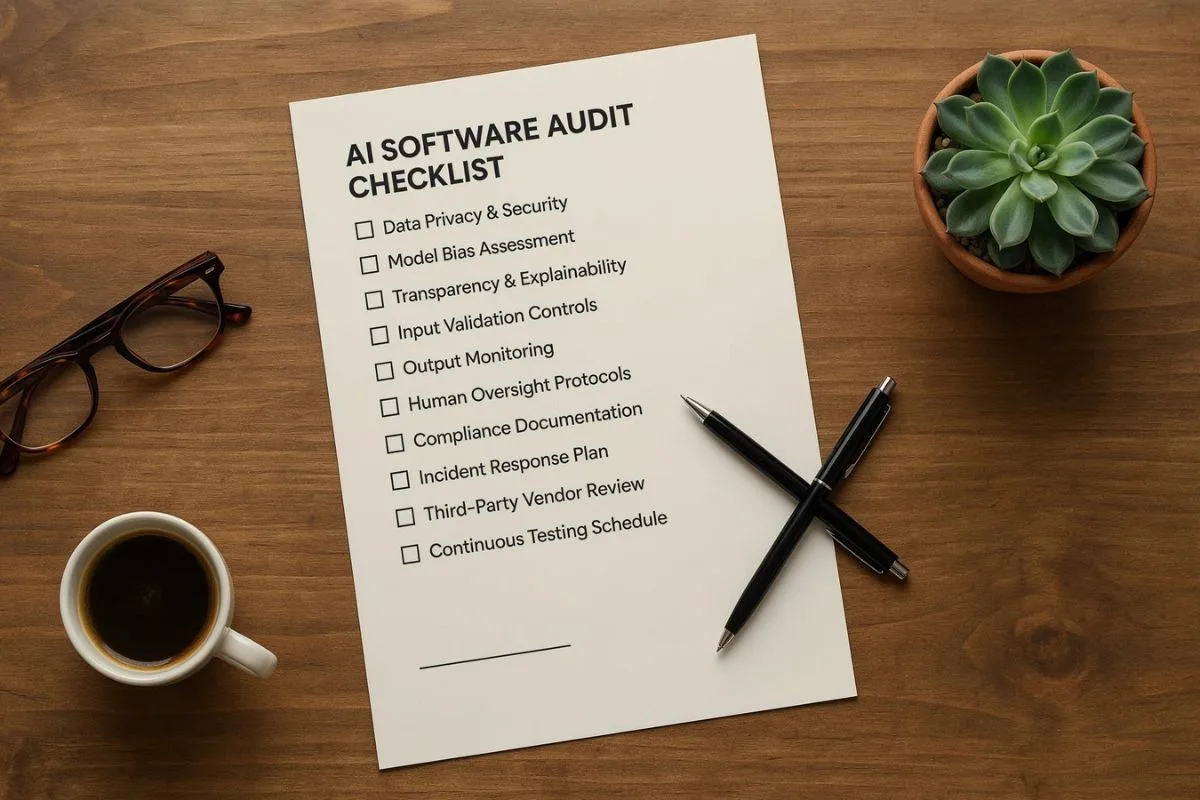
Artificial intelligence (AI) and machine learning are becoming increasingly important across pharmaceutical research, manufacturing, quality, clinical, and regulatory processes. However, using AI in a regulated environment creates new compliance considerations around data, software validation, model performance, human oversight, security, and change management.
A structured AI software audit checklist helps pharmaceutical companies evaluate whether an AI application is suitable for its intended use and whether appropriate controls are in place throughout its lifecycle.
For GxP environments, an AI audit should go beyond checking whether the software works. Auditors should also examine how the system was developed, validated, monitored, changed, documented, and controlled.
Also read: AI Software Compliance Audits in Pharma: Complete 2026 Guide
What Is an AI Software Audit?
An AI software audit is a systematic review of an artificial intelligence or machine learning application to determine whether it meets defined quality, compliance, security, and performance expectations.
In pharmaceutical environments, the audit may consider:
- Intended use and context of use
- GxP impact and risk classification
- Data governance and data integrity
- AI model development and validation
- Software lifecycle controls
- Human oversight
- Audit trails and access controls
- Cybersecurity
- Change management
- Vendor controls
- Regulatory and quality requirements
FDA’s current risk-based software assurance guidance specifically includes artificial intelligence and machine learning tools among technologies that can be considered within a risk-based assurance framework when used in production or quality management systems.
AI Software Audit Checklist for Pharmaceutical Companies
The following checklist can help auditors and pharmaceutical organizations review important areas of an AI application.
1. AI System Inventory and Risk Assessment
The first step is identifying all AI and machine learning applications used within the organization.
Check whether:
- All AI systems are listed in an approved inventory.
- The intended use of each AI application is documented.
- The context of use is clearly defined.
- Each system has undergone a documented risk assessment.
- GxP impact has been evaluated.
- Critical or high-risk applications receive appropriate controls.
- System ownership and accountability are clearly assigned.
- Risk assessments are periodically reviewed and updated.
A risk-based approach is particularly important because not every AI application has the same impact on product quality, patient safety, data integrity, or regulatory decisions.
2. AI Governance and Oversight
Effective AI governance establishes who is responsible for approving, monitoring, and controlling AI systems.
An audit should determine whether:
- A documented AI governance framework exists.
- Roles and responsibilities are defined.
- AI system owners have been assigned.
- Quality and regulatory functions are involved where required.
- AI use is subject to appropriate approval procedures.
- Model changes are controlled.
- AI performance is periodically reviewed.
- Escalation procedures exist for unexpected results.
- Governance requirements are applied throughout the AI lifecycle.
FDA and EMA’s joint principles for good AI practice in drug development emphasize human-centric design, risk-based approaches, clear context of use, multidisciplinary expertise, data governance, model development, performance assessment, and lifecycle management.
3. Training Data Quality and Governance
AI performance depends heavily on the quality and suitability of its data.
The AI software audit checklist should therefore examine:
- Whether training data comes from reliable sources.
- Whether data is appropriate for the intended use.
- Whether data sources are documented.
- Whether data completeness has been evaluated.
- Whether preprocessing activities are documented.
- Whether data quality checks are performed.
- Whether potential bias has been assessed.
- Whether data changes are controlled.
- Whether data lineage can be demonstrated.
- Whether data retention requirements are defined.
For GxP systems, organizations should also consider whether data remains attributable, legible, contemporaneous, original, and accurate. EMA identifies ALCOA principles as a key part of pharmaceutical data integrity expectations.
4. AI Model Development and Validation
AI models should be developed and evaluated using a controlled and documented process.
Auditors should check:
- Whether model requirements are documented.
- Whether the development methodology is defined.
- Whether acceptance criteria are established.
- Whether appropriate performance metrics are selected.
- Whether independent test data is used.
- Whether validation activities are documented.
- Whether model limitations are identified.
- Whether expected performance ranges are established.
- Whether model performance is monitored after deployment.
- Whether deviations from expected performance are investigated.
The depth of assurance should reflect the AI application’s intended use and risk.
5. AI Model Documentation
Complete documentation is essential for demonstrating that an AI system is controlled and suitable for its intended purpose.
Review whether documentation includes:
- Intended use and context of use
- Model architecture
- Input and output specifications
- Training data information
- Data preprocessing methods
- Model assumptions
- Known limitations
- Performance criteria
- Validation results
- Version history
- Change history
- Approval records
- Monitoring requirements
Clear documentation also helps auditors understand how an AI system reaches or supports a particular outcome.
6. Human Oversight and Intervention
AI should not automatically replace appropriate human responsibility in regulated processes.
An audit should assess whether:
- Human review of AI outputs is defined.
- Personnel understand when intervention is required.
- Users can override AI recommendations where appropriate.
- Human interventions are documented.
- Escalation procedures are established.
- AI limitations are communicated to users.
- Personnel receive appropriate training.
- Critical decisions have suitable human oversight.
Human-centric design is one of the principles highlighted by FDA and EMA for responsible AI use in drug development.
7. Data Integrity and Audit Trails
Data integrity is a critical part of an AI audit pharma assessment because AI applications may process large volumes of data and generate outputs that influence regulated activities.
Auditors should verify:
- Audit trails are enabled where required.
- User access is controlled.
- AI inputs and outputs can be traced.
- Data changes are recorded.
- Model changes are documented.
- Critical records are protected from unauthorized modification.
- Electronic records are appropriately controlled.
- Data remains accurate and reliable throughout its lifecycle.
FDA’s GMP guidance also emphasizes validation and controls over computerized systems, including controls against unauthorized access or data changes.
8. AI Software Security
Security risks should be included in the pharmaceutical AI audit.
The review may cover:
- User authentication
- Role-based access
- Privileged access management
- Data encryption
- Secure interfaces
- Protection against unauthorized model changes
- Protection against malicious inputs
- Data poisoning risks
- Model theft risks
- Security monitoring
- Incident response
- Security documentation
Security controls should be appropriate to the AI application’s risk, data sensitivity, and intended use.
9. Regulatory and GxP Compliance
AI systems used in regulated processes should be evaluated against applicable regulatory and quality requirements.
Depending on the system and its intended use, an audit may review:
- GxP requirements
- Data integrity expectations
- Computerized system validation or assurance
- 21 CFR Part 11 where applicable
- EU GMP Annex 11 where applicable
- Internal quality procedures
- Electronic record controls
- Change control
- Deviation management
- CAPA requirements
- Applicable FDA and EMA expectations
Importantly, regulatory requirements should be assessed according to the actual intended use of the AI system rather than assuming that every AI application requires the same level of validation.
FDA’s 2026 Computer Software Assurance guidance supports a risk-based approach to determining appropriate assurance activities and specifically recognizes AI/ML tools within its examples.
10. AI Vendor and Supplier Management
Many pharmaceutical organizations use third-party AI platforms, cloud services, models, or software providers. These suppliers should therefore be included in the audit strategy.
Check whether:
- The AI vendor has been appropriately qualified.
- Supplier risk has been assessed.
- A quality agreement exists where required.
- Vendor responsibilities are documented.
- Validation or assurance documentation is available.
- Software updates are communicated.
- AI model changes are controlled.
- Vendor performance is periodically reviewed.
- Supplier audits are performed when justified by risk.
- Business continuity and contingency plans exist.
Third-party AI should not be treated as outside the organization’s quality responsibility simply because the underlying technology is supplied by another company.
11. AI Change Management and Lifecycle Control
AI systems can change over time because of software updates, model retraining, new datasets, configuration changes, or modifications to algorithms.
An audit should therefore verify:
- AI changes are formally documented.
- Change requests are risk assessed.
- Model updates are reviewed before implementation.
- Validation or testing is performed when required.
- Approval is documented.
- Previous versions can be identified.
- Retraining activities are controlled.
- Post-change performance is evaluated.
- Unexpected changes are investigated.
Lifecycle management is an important part of current AI governance principles, particularly where AI systems may evolve after initial implementation.
12. AI Performance Monitoring
An AI system should continue to perform as expected after deployment.
Organizations should define appropriate monitoring for:
- Accuracy
- Reliability
- Model performance
- Data quality
- Unexpected outputs
- Drift
- Bias
- Error rates
- User feedback
- Critical incidents
- Performance against acceptance criteria
Where an AI system is used for a regulated activity, predefined actions should exist for performance deterioration or unexpected behavior.
Common Findings During AI Software Audits
Some common findings may include:
- Incomplete AI system inventories
- Missing or unclear intended-use documentation
- Weak AI governance
- Poor training data documentation
- Inadequate data lineage
- Insufficient model validation
- Missing model limitations
- Weak change control
- Inadequate human oversight
- Poor audit trail controls
- Incomplete vendor qualification
- Insufficient cybersecurity controls
- Lack of ongoing performance monitoring
Identifying these issues early can help organizations address compliance gaps before they become larger quality or regulatory concerns.
How to Prepare for an AI Software Audit
Pharmaceutical companies can improve audit readiness by taking a structured approach.
Before an audit:
- Identify all AI applications.
- Document intended use and context of use.
- Complete a risk assessment.
- Review data governance and integrity controls.
- Verify validation and assurance documentation.
- Review model development records.
- Check change-control history.
- Assess human oversight.
- Review cybersecurity controls.
- Evaluate AI vendors.
- Review performance monitoring.
- Track and close identified CAPA actions.
A pre-audit assessment can help identify missing documentation and control weaknesses before a formal audit or regulatory inspection.
How GxP Cellators Supports AI Software Audits
GxP Cellators provides AI software auditing services for pharmaceutical and other regulated organizations seeking to evaluate the compliance, quality, and control of AI applications.
Its AI audit support can include:
- AI software compliance audits
- Pre-audit readiness assessments
- AI governance reviews
- AI risk assessments
- Training data quality reviews
- Data integrity assessments
- AI model validation documentation reviews
- Human oversight assessments
- AI cybersecurity assessments
- Regulatory compliance reviews
- Vendor and supplier audits
- Mock audit support
- CAPA review and follow-up
GxP Cellators applies a risk-based approach to help organizations identify practical gaps and develop actionable improvement plans.
Why Choose GxP Cellators for AI Software Auditing?
GxP Cellators combines GxP compliance knowledge with an understanding of emerging AI technologies to support organizations implementing AI in regulated environments.
The approach focuses on:
- Risk-based audit planning
- GxP and quality considerations
- Data integrity
- AI governance
- Software assurance and validation
- Regulatory expectations
- Practical audit findings
- Corrective and preventive actions
- Confidential handling of client information
The objective is not simply to identify problems but to help organizations understand the compliance risk and prioritize appropriate corrective actions.
Frequently Asked Questions
What should be included in an AI software audit checklist?
An AI software audit checklist should cover system inventory, intended use, risk assessment, governance, data quality, model development, validation, documentation, human oversight, data integrity, cybersecurity, regulatory compliance, change management, performance monitoring, and vendor management.
How often should AI software audits be conducted?
There is no single audit frequency for every AI application. The appropriate frequency should be based on factors such as GxP impact, system criticality, risk, changes to the model or software, vendor risk, and previous audit findings. Higher-risk applications may require more frequent review.
Who should conduct an AI software audit?
AI software audits should be performed by professionals who understand both AI technologies and regulated environments. Auditors should have knowledge of GxP requirements, software validation or assurance, data integrity, risk management, and AI lifecycle controls.
What are common findings in AI software audits?
Common findings can include incomplete system inventories, unclear intended use, inadequate governance, weak training data documentation, insufficient model validation, missing change controls, inadequate human oversight, weak data integrity controls, and incomplete vendor management.
Is AI software validation required in pharmaceutical environments?
The appropriate level of validation or software assurance depends on the intended use and risk of the system. GMP-related computerized systems require appropriate controls and validation, with the depth and scope depending on factors such as application complexity and criticality.
How does GxP Cellators support AI software audits?
GxP Cellators provides AI software auditing services covering risk assessment, governance, data integrity, model documentation, validation review, human oversight, cybersecurity, regulatory compliance, vendor assessment, mock audits, and CAPA follow-up.
How can I contact GxP Cellators for AI software audit support?
Organizations looking for AI software audit support can contact GxP Cellators to discuss their AI application, intended use, GxP requirements, and audit objectives.
Also read: How to Prepare for an AI Application Validation Audit in GxP
Contact GxP Cellators
If your pharmaceutical organization is implementing AI or already using AI in a GxP environment, a structured audit can help identify compliance risks and strengthen controls.
Contact GxP Cellators for AI software auditing support and discuss your requirements with the team.

