
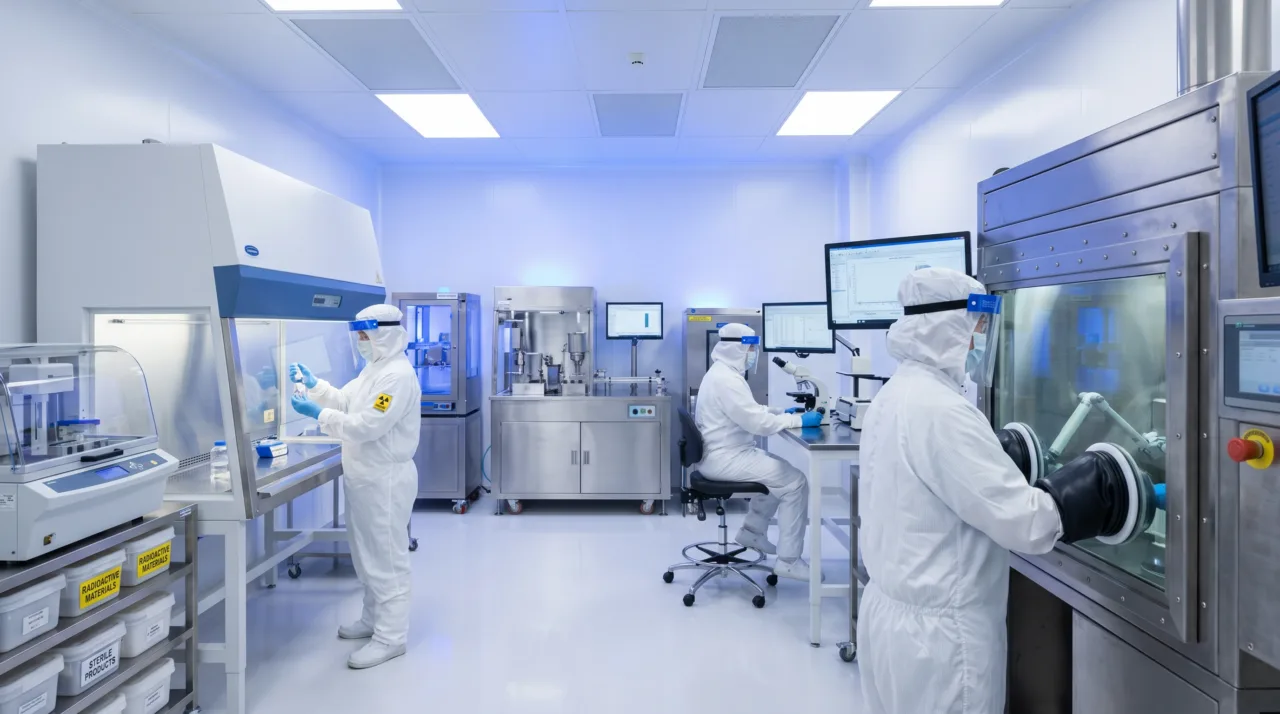
If you work in nuclear medicine or radiopharmacy, you already know this. Making a radiopharmaceutical is not like manufacturing regular drugs. You are not working on a batch that sits on a warehouse shelf for two years. You are working against a radioactive decay clock, often measured in minutes or hours.
I have been inside enough PET production facilities and hospital radiopharmacies to see what works and what fails. The difference between a smooth operation and a regulatory nightmare almost always comes down to one thing. A quality management system that actually fits the unique demands of radioactive drugs.
Let me walk you through the real manufacturing process first. Then I will explain why your QMS might be putting you at risk.
WHERE THE RADIOACTIVITY COMES FROM
Before anyone draws a dose or fills a vial, the radionuclide has to be produced. There are three common sources.
Cyclotrons for PET drugs. Fluorine 18, carbon 11, nitrogen 13, and oxygen 15 are all made by slamming charged particles into a target. For fluorine 18, that target is often enriched water. The cyclotron itself is not the scary part. It is the target system. If the target body has residue from a previous irradiation, or if a seal is degraded, you introduce radionuclidic impurities. I have seen batches rejected because someone skipped a target cleaning. That is an expensive mistake when your half life is 110 minutes.
Radionuclide generators. The molybdenum 99 and technetium 99m generator is the workhorse of nuclear medicine. You elute it with sterile saline, and out comes sodium pertechnetate Tc 99m. But here is what people forget. Every eluate needs to be tested for molybdenum 99 breakthrough. That limit is tiny, usually 0.15 microcuries of molybdenum 99 per millicurie of technetium 99m at the time of administration. If you do not test, or if your generator is past its useful life, you are injecting a patient with a longer lived contaminant. That is not just a quality issue. That is a patient safety issue.
Cold kits. A cold kit is a vial of non radioactive ingredients. Ligand, reducing agent, buffer. You add the radionuclide eluate, incubate, and the radiopharmaceutical is ready. Sounds simple. But the moment you deviate from the manufacturer’s instructions, different volume, different activity, longer incubation, you have left preparation and entered compounding. That triggers different rules, different beyond use dates, and different testing requirements. A lot of people miss that line.
THE ACTUAL MANUFACTURING STEPS
Once you have your radionuclide source, the real work begins. Here is what a typical production looks like in a sterile radiopharmaceutical facility.
Step 1: Assemble your components inside ISO Class 5. You need a sterile vial, a sterilizing grade filter with 0.22 micron pore size, a filling needle, and a vent needle with its own sterile filter. All of that gets assembled inside an ISO Class 5 environment. That could be a laminar airflow workbench, a biological safety cabinet, or a hot cell. If you are using a hot cell, remember that the lead shielding interrupts unidirectional airflow. You absolutely need smoke studies to prove that first air reaches the critical sites. I have walked into facilities where no one had ever done an airflow visualization inside the hot cell. That is a finding waiting to happen.
Step 2: Perform the radiolabeling or synthesis. For a kit, you aseptically add the eluate to the cold kit vial. For a PET drug, you run an automated synthesis module. Those modules are computer controlled, with cassettes, reagent vials, and purification cartridges. The software has to be validated. The day of system checks such as temperature, pressure, and valve function get recorded in the batch record. And if you change anything, a different supplier for a precursor or a new column lot, that goes through change control. I cannot tell you how many times I have seen facilities skip change control because it is the same part, just a different vendor. That is not how good manufacturing practice works.
Step 3: Sterilize by filtration. Because most radiopharmaceuticals cannot be autoclaved, they are heat sensitive and short lived, you rely on sterile filtration. The 0.22 micron filter is your last line of defense against microorganisms. After filtration, you must perform an integrity test, either bubble point or pressure decay. If that test fails, your batch is not sterile. You cannot release it unless you have a validated reprocessing step such as refiltration, and even then, you have to document everything. A failed integrity test after the product has already been administered? That is an immediate notification to the receiving facility and the prescriber, followed by a full investigation.
Step 4: Quality control testing, what you do before release and what you do after. Here is where radiopharmaceuticals get complicated. You will not have sterility results before the patient gets the dose. That is just reality when your half life is two hours. But you still have to test.
Before release, you must have:
- Radiochemical purity, usually by thin layer chromatography or high performance liquid chromatography, with acceptance criteria like 90 percent or 95 percent.
- Radiochemical identity, confirming that the radioactive species is what you think it is.
- Radionuclidic purity, meaning no molybdenum 99 breakthrough in technetium 99m and no long lived contaminants in PET drugs.
- pH and appearance, clear with no visible particles.
- A passed filter integrity test.
After release, you run:
- Sterility testing, which takes 14 days of incubation in fluid thioglycollate medium and tryptic soy broth.
- Bacterial endotoxin testing, using limulus amebocyte lysate.
If either sterility or endotoxins fails after the patient received the dose, you have to notify immediately. I have seen facilities drag their feet on post release failures because they did not want to admit a problem. That is how you lose your license.
Step 5: Label, shield, and distribute. The label on the immediate container has to show the radiation trefoil symbol, the drug name and radionuclide, total radioactivity at a stated calibration time, the beyond use date, and the route of administration. For therapeutic products or blood cell labels, you also need the patient identifier. The outer shielding, which could be a lead pot or transport overpack, gets its own label with similar information plus a transport index if required by DOT or IATA.
Distribution records have to be traceable to the individual dose. If you have to recall a batch, and yes that happens, you need to know exactly which hospital and which patient received each unit within minutes. Physical return is rarely possible because the drug has decayed or been administered. Your recall is to prevent further use and notify the prescriber.
THE PART NOBODY WANTS TO TALK ABOUT: YOUR QMS
I have watched facilities spend hundreds of thousands of dollars on cyclotrons, synthesis modules, and hot cells. Then they run their quality system from a shared drive, with uncontrolled standard operating procedures and no deviation tracking.
That does not work.
A proper quality management system for radiopharmaceutical manufacturing must address several critical areas.
Conditional release. You are shipping product before sterility results are back. That means your quality system must include a procedure for conditional release, including documentation of why the release is justified, which tests are pending, and how you will notify recipients if a delayed test fails. If that procedure is not written and followed, you are releasing product without a net.
Deviation and CAPA. When a radiochemical purity result comes back at 87 percent instead of the required 95 percent, what do you do? You investigate. Was it the synthesis module? The reagent? The column? The operator? You document the root cause, decide whether the batch can be released, which is usually not, and implement corrective and preventive actions. If you do not have a disciplined CAPA system, the same deviation will happen again next week.
Change control. You want to switch from one brand of sterile filter to another. That is a change. You want to modify your synthesis method to improve yield. That is a change. You want to extend the beyond use date of a compounded preparation from 12 hours to 24 hours. That is absolutely a change, and it requires stability data and revalidation. I have seen facilities make these changes quietly, hoping no one notices. Inspectors notice.
Personnel qualification. Your aseptic technique is not just trained once. It has to be requalified. Media fill tests, in which you substitute the growth medium for the drug product and simulate the entire process, should be performed at least annually. Gloved fingertip sampling should happen at least annually too. If an operator fails a media fill, they are not allowed to continue working. They get retrained and retested. That needs to be in your QMS, and you need the records to prove it happened.
Environmental monitoring. You are required to sample viable air, non viable particles, and surfaces on a defined schedule. ISO Class 7 buffer rooms typically need viable air sampling every six months and surface sampling monthly. If an action limit is exceeded, you investigate. If you identify a microorganism, you should identify it to at least the genus level so you know whether it came from a human (e.g., Staphylococcus), a water source (e.g., Pseudomonas), or an air-handling failure (e.g., Bacillus). Then you fix the root cause. That only works if your QMS has a procedure for environmental excursions.
WHY GXP CELLATORS CONSULTANTS
You do not need generic pharmaceutical consultants who learned about radiopharmaceuticals from a webinar. You need people who understand that a hot cell is not a cleanroom bench, and that a 110 minute half life changes everything about batch release.
GxP Cellators works exclusively in the gap between complex good manufacturing practice requirements and real world radiopharmaceutical operations. Here is what we actually do.
Good Distribution Practices I GDP I GDP Auditing I
QMS Design for Radiopharmaceuticals
We build quality systems that match your specific workflow. Whether you are running a PET center with three cyclotron runs per day, a hospital radiopharmacy doing technetium 99m kit preparations, or a commercial facility manufacturing and distributing therapeutic radiopharmaceuticals like lutetium 177 DOTATATE.
We write standard operating procedures that make sense for short lived products. We set up change control that does not choke your production but also does not let critical changes slip through. We design deviation and CAPA systems that actually get used, not just filed away.
Auditing Services
We conduct internal audits, mock regulatory inspections, and gap assessments against the following standards.
- United States FDA: 21 CFR Part 211, Part 212 for PET drugs, Part 312 for investigational new drugs, Part 361 for RDRC research.
- United States Pharmacopeia: General Chapters <797>, <825>, and <823>.
- European Commission: EudraLex Volume 4, Annex 3.
- Health Canada: Annex 3A for Schedule C drugs and Annex 3B for PET radiopharmaceuticals.
We do not just hand you a list of findings. We sit with your team, explain why each finding matters in the context of your specific operation, and help you prioritize corrective actions. Then we come back to verify that the fixes worked.
A FEW FINAL THOUGHTS
Radiopharmaceutical manufacturing is not forgiving. You cannot hold a batch for two weeks while you wait for sterility results. You cannot easily retest because the product decayed. You cannot recall a dose after it has been injected.
The only thing standing between a safe, compliant operation and a serious problem is your quality management system. Not your cyclotron. Not your synthesis module. Your QMS.
If your current system has gaps, and most do, you owe it to your patients and your team to fix them before an inspector finds them for you.
Contact GxP Cellators Consultants
- Email us directly:
- Visit our website: www.gxpcellators.com
Tell us what you are working on. A new PET facility. An existing radiopharmacy is preparing for an FDA inspection. A hospital trying to align with USP <825>. We will tell you honestly whether we can help and exactly what it would take.
Let us make your quality system something you are proud to show an inspector.

