
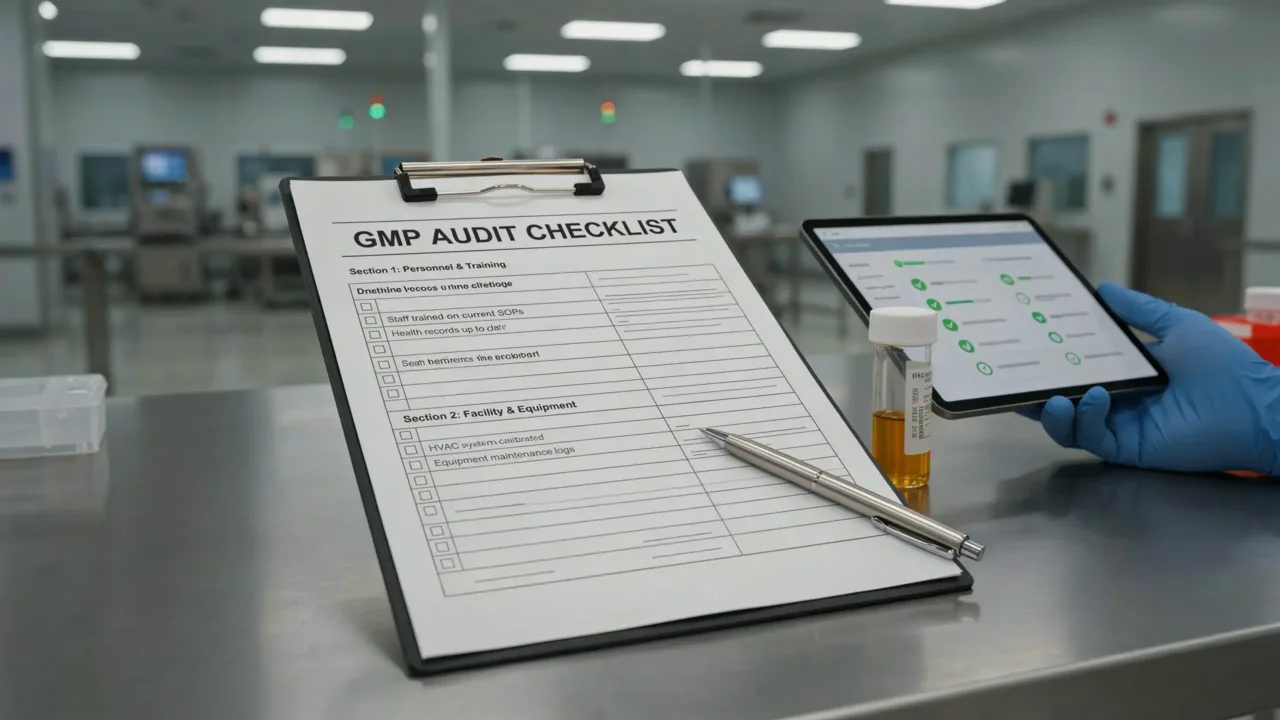
Why a Checklist Alone Is Not Enough
A GMP audit checklist is a structured list of questions and evidence points used to verify compliance with Good Manufacturing Practice requirements. Most pharmaceutical teams have one. Many have several, inherited from past audits, client questionnaires, or regulatory guidance documents. The problem is not the absence of a checklist. The problem is that checklists tend to repeat the same familiar items while missing the areas where findings actually cluster.
Regulators publish their inspection trends, and the patterns are consistent. The gaps that appear year after year are rarely about missing equipment or absent procedures. They are about whether systems work in practice, whether data can be trusted, and whether the people doing the work understand why the controls exist. A checklist that only asks whether a procedure exists will miss all of that.
The Regulatory Context Behind Common Checklist Gaps
FDA 21 CFR Parts 210 and 211
The FDA sets cGMP requirements for finished pharmaceuticals across organization, buildings, equipment, production controls, laboratory controls, and records. Specific data integrity requirements appear in 21 CFR 211.68, which requires backup data to be true, complete, and secure, and 21 CFR 211.180, 211.188, and 211.194, which address record retention, batch production records, and laboratory test data. A checklist that does not probe these areas directly is incomplete.
EU GMP and Annex 1
EudraLex Volume 4 covers the full EU GMP framework. For sterile manufacturers, Annex 1, revised effective August 2023, introduced the contamination control strategy as a central requirement. WHO inspection trends from 2023 and 2024 show that contamination control strategy gaps are among the most frequent major observations for sterile manufacturers, including unaddressed glove controls in RABS, undocumented operator interventions in Grade A, and inadequate separation between Grade A and Grade B areas .
Data Integrity Under MHRA and PIC/S
The MHRA Data Integrity guidance requires retained audit trails, no shared or generic user accounts, and demonstrated progress toward individual login and audit trails for legacy automation systems. PIC/S Guide PE 009 Annex 1 includes the same contamination control expectations for sterile products. WHO inspection findings for APIs in 2023 and 2024 repeatedly cite missing data integrity policies, absent data integrity risk assessments, unlocked date and time stamps, shared passwords, and audit trails not reviewed before batch release .
What Teams Often Miss
The Contamination Control Strategy as a Living Document
Many sterile manufacturers have a contamination control strategy document. Fewer can show that it is used. WHO inspection findings show that strategies often fail to address operator interventions, equipment design details, and the interaction between Grade A and Grade B areas. A checklist item that asks “Is a CCS available?” misses the real question: does the CCS reflect what actually happens on the floor?
Data Integrity Controls for Standalone and Legacy Systems
Teams often focus data integrity efforts on major computerized systems like LIMS and CDS. Standalone equipment, balances, and legacy automation are frequently overlooked. WHO API findings include unlocked balance timestamps, shared IT administrator passwords, and analysts with privileges to manually integrate chromatographic data and delete files. Audit trails were not reviewed before batch release . MHRA guidance specifically expects progress toward individual login and audit trails for industrial automation and control equipment including PLCs, HMIs, and SCADA platforms .
Operator Practices in Aseptic Areas
A checklist can confirm that a media fill was performed. It cannot confirm that the media fill design reflects actual worst case interventions. WHO findings describe operators entering Grade A during setup without the practice being assessed in the CCS, and filling lines where Grade A capping machines were not isolated from Grade B backgrounds with no risk assessment performed .
Deviation and CAPA Depth
Checklists often ask whether deviations were closed. Fewer ask whether investigations reached a defensible root cause. Repeat findings across inspections often trace back to investigations that stopped at the immediate cause.
Training Effectiveness
Training records can show completion. They cannot show competence. Health Canada GUI-0001 addresses training requirements and supervisory qualifications explicitly, which signals that training effectiveness is part of the regulatory expectation, not just a human resources metric.
Introducing GxP Cellators for GMP Auditing
GxP Cellators provides GMP auditing services that go beyond checklist verification. Our auditors walk your floors, review batch records, and trace deviation history to find gaps before inspectors do. We cover FDA 21 CFR Parts 210 and 211, EU EMA EudraLex Volume 4, Health Canada GUI-0001, UK MHRA Orange Guide, WHO Technical Report Series, and PIC/S Guide PE 009.
Our audit scope includes sterile manufacturing facilities, non sterile manufacturing facilities, contract manufacturing organizations, quality systems and validation, and batch release and inspection readiness. For sterile sites, we audit cleanroom design and classification, air flow patterns, personnel and material flows, environmental monitoring programs, aseptic technique, media fill design and execution, sterilization validation, isolator integrity, and container closure integrity. For quality systems, we review documentation control, deviation investigation depth, CAPA effectiveness, change control impact assessment, training effectiveness, self inspection scope, and data integrity controls aligned with ALCOA plus principles.
We offer internal GMP audits, supplier and vendor audits, CMO audits, pre approval inspection readiness audits, for cause audits, follow up and CAPA verification audits, and mock regulatory inspections. Our process runs from planning and opening meeting through fieldwork, closing meeting, reporting, and follow up.
Start With a Better Audit
Review our full services at https://www.gxpcellators.com/gmp-auditing/. Email or use https://www.gxpcellators.com/contact/ to request a scoping call.
Frequently Asked Questions About GMP Audit Checklists
What should a GMP audit checklist include?
A useful checklist covers facility and equipment, documentation, production controls, laboratory controls, data integrity, deviation and CAPA systems, training effectiveness, and supplier oversight. For sterile products, it should also cover contamination control strategy elements and aseptic practices.
Why do teams miss findings even with a checklist?
Checklists verify that documents and systems exist. They often do not test whether systems work in practice. Findings cluster in areas where practice diverges from procedure, such as data integrity controls on standalone equipment or operator interventions in aseptic areas.
How often should the checklist be updated?
At minimum, review it when regulations change, such as the Annex 1 revision, and when inspection trends shift. WHO and PIC/S publish inspection findings that show where regulators are focusing.
Can you audit against our existing checklist?
Yes. We can use your checklist as a starting point and supplement it with areas drawn from current inspection trends and regulatory requirements.
Do you provide a checklist we can use internally?
We can share the framework we use as part of an engagement. The value is in the audit execution, not just the list.
How do I request a GMP audit?
Email or use https://www.gxpcellators.com/contact/. Service details are at https://www.gxpcellators.com/gmp-auditing/.

