

Validate AI-Based Computerized Systems GxP Archives | GxP Cellators Consultants Ltd.

12/10/2026
AI-Based-Computerized-Systems-1280x720.webp

Artificial intelligence (AI) is becoming increasingly important in pharmaceutical manufacturing, laboratory operations, clinical research, and other regulated industries. Organizations use AI-based computerized systems to analyze data, support quality decisions, identify risks, and improve operational efficiency. However, when these systems support regulated activities, they must meet applicable Good Practice (GxP) requirements.

Validating AI-based computerized systems in a GxP environment requires a structured approach that goes beyond traditional Computerized System Validation (CSV). Unlike conventional software, some AI systems can produce results that depend on training data, model configuration, changing inputs, or model updates. Therefore, organizations must understand how these systems work, what risks they introduce, and how their performance can be monitored throughout their lifecycle.

This guide explains how to validate AI-based computerized systems in a GxP environment, covering intended use, training data, model development, human oversight, data integrity, and ongoing monitoring.

GxP Cellators provides GxP auditing, computerized system validation support, data integrity assessments, and regulatory compliance services to help organizations evaluate AI-related compliance risks and strengthen their validation processes.

What Is AI-Based Computerized System Validation in GxP?

AI-based computerized system validation is the documented process of establishing that an AI-enabled system is suitable for its intended use and performs reliably within its defined operating environment. The validation approach should be proportionate to the system’s intended use, complexity, and potential impact on product quality, patient safety, and data integrity.

Traditional CSV principles remain relevant, including documented requirements, risk assessment, testing, traceability, change control, and periodic review. However, AI systems may require additional controls because their outputs can be influenced by training data, model behavior, and changes in the operating environment.

For example, an AI tool used to support laboratory result review may affect decisions about data quality. Similarly, an AI application used in pharmaceutical manufacturing may help identify process deviations. If such systems support GxP activities, organizations should establish appropriate controls and document how their reliability and suitability have been evaluated.

AI validation does not automatically require the same testing approach for every system. Instead, the validation strategy should reflect the actual risks and intended use.

Step 1: Define Intended Use and Requirements

The first step is to clearly define the intended use of the AI-based computerized system. Organizations should document what the system is designed to do, which processes it supports, and how its outputs will be used.

A clear intended-use statement helps determine the scope of validation and the controls required throughout the system lifecycle.

Key activities include:

  • Documenting the intended use and purpose of the AI system.
  • Defining functional and non-functional requirements.
  • Identifying the GxP activities supported by the system.
  • Assessing potential impacts on product quality, patient safety, and data integrity.
  • Establishing measurable acceptance criteria.
  • Identifying system users, responsibilities, and access requirements.

A risk assessment should also determine the potential consequences of incorrect, incomplete, or unreliable AI outputs. For example, an AI system that provides recommendations for a quality decision may require different controls from one that performs a purely administrative task.

Requirements should be clear enough to support objective testing. Where an AI model produces probabilistic outputs, acceptance criteria should explain how its performance will be assessed and what limitations apply.

Step 2: Assess and Prepare Training Data

Training data plays a major role in AI system performance. Incomplete, inaccurate, unrepresentative, or biased data can affect model outputs and introduce compliance risks.

Therefore, organizations should evaluate the quality and suitability of training, validation, and test datasets as applicable to the AI model and its intended use.

Important activities include:

  • Documenting training data sources and ownership.
  • Assessing data completeness, accuracy, and representativeness.
  • Recording data cleaning and preprocessing activities.
  • Evaluating potential bias in the datasets.
  • Establishing controls for data access and protection.
  • Documenting known data limitations and their potential impact.
  • Maintaining traceability between datasets, model versions, and validation evidence.

Data preparation activities should be documented so that reviewers can understand how the data was selected, transformed, and used.

Organizations should also determine whether the data reflects the conditions in which the AI system will operate. A model trained using one type of process or dataset may not perform equally well under different conditions.

For GxP applications, training data quality assessments should be proportionate to the risk. Where data supports critical decisions, stronger evidence of data suitability, traceability, and integrity may be necessary.

Step 3: Document Model Development and Validation

AI model development should be sufficiently documented to support review, testing, and future maintenance. The level of detail will depend on the model type, system architecture, intended use, and regulatory risk.

Organizations should maintain records that explain how the model was developed and how its performance was evaluated.

Documentation should cover:

  • Model development methodology and architecture.
  • Key assumptions and known limitations.
  • Training, validation, and test data used.
  • Model configuration and version information.
  • Testing methods and performance metrics.
  • Validation results and acceptance criteria.
  • Identified risks and mitigation measures.
  • Approval records and supporting evidence.

Testing should evaluate whether the model performs as expected under defined conditions. Depending on the intended use, this may include accuracy, precision, sensitivity, specificity, robustness, reproducibility, or other appropriate performance measures.

Organizations should also consider how the model behaves with unusual, incomplete, or unexpected inputs. Testing only typical scenarios may not provide sufficient evidence of suitability for a regulated application.

Where applicable, the validation package should establish traceability between requirements, identified risks, test cases, results, and conclusions. This makes it easier to demonstrate why the system is considered suitable for its intended use.

Step 4: Establish Appropriate Human Oversight

Human oversight is an important control when AI outputs influence GxP decisions. Organizations should clearly define when human review is required, who is responsible for reviewing outputs, and what actions can be taken when the system produces questionable results.

Human oversight should be based on risk rather than treated as a general approval step.

Key activities include:

  • Defining human review and approval procedures.
  • Establishing override, rejection, and escalation processes.
  • Documenting significant human interventions.
  • Training personnel on the system’s capabilities and limitations.
  • Defining responsibilities for investigating unexpected outputs.
  • Maintaining records of decisions where required.

For example, if an AI system flags a potential quality issue, a qualified person may need to review the supporting evidence before taking further action. The review process should explain how disagreements between the AI output and human judgment are handled.

Training should help users understand that AI outputs may contain errors and should not automatically be accepted as correct. Personnel must also know when to escalate concerns and how to report unexpected system behavior.

The required level of oversight will depend on the system’s intended use, risk classification, and role in regulated decision-making.

Step 5: Implement Data Integrity and Security Controls

Data integrity is essential when AI-based computerized systems process or generate information used in GxP activities. Organizations should establish appropriate controls to protect records from unauthorized access, unintended changes, loss, or inappropriate deletion.

The controls should support applicable data integrity principles and relevant regulatory requirements.

Important measures include:

  • Implementing role-based access controls.
  • Maintaining appropriate audit trails for relevant records and activities.
  • Recording model versions and significant configuration changes.
  • Protecting input data, outputs, and associated metadata.
  • Establishing backup and recovery procedures.
  • Documenting data transfers and system interfaces.
  • Reviewing security risks and access permissions periodically.
  • Monitoring relevant data integrity issues.

Audit trails should provide suitable evidence of important activities, such as changes to records, model configurations, and system settings, where applicable. Organizations should also determine whether AI-generated outputs need to be retained and linked to the information used to produce them.

Data governance procedures should define responsibilities for managing datasets, model updates, access permissions, and records retention. These controls help maintain traceability and support investigations when unexpected results occur.

Step 6: Establish Ongoing Monitoring and Periodic Review

AI validation should not end when a system is initially approved. Depending on the technology, intended use, and risk, ongoing monitoring may be necessary to confirm that the system continues to perform as expected.

Changes in data, operating conditions, software components, or model versions can affect performance. Organizations should therefore establish a documented process for reviewing system performance throughout its lifecycle.

Ongoing monitoring activities may include:

  • Defining relevant performance indicators.
  • Establishing monitoring thresholds and review responsibilities.
  • Monitoring unexpected outputs and performance degradation.
  • Recording incidents, deviations, and investigations.
  • Evaluating proposed model or configuration changes.
  • Scheduling risk-based periodic reviews.
  • Updating validation documentation when necessary.
  • Establishing response and escalation plans.

Organizations should define what happens when a system fails to meet its established acceptance criteria. Depending on the impact, possible actions may include additional investigation, restricting system use, reverting to an approved configuration, or performing further testing before reapproval.

A formal change control process should determine whether changes require additional testing, regression testing, or partial or full revalidation. The decision should be documented and based on risk.

Common Challenges in AI-Based GxP Validation

Organizations may encounter several challenges when validating AI-enabled systems. Understanding these issues early can help establish a more effective validation strategy.

Limited Model Transparency

Some AI models are difficult to interpret. Organizations should document the available information about model behavior, limitations, and suitability for the intended use.

Inadequate Training Data

Poor-quality or unrepresentative datasets may lead to unreliable outputs. Data quality assessments and documented data governance procedures can help reduce this risk.

Changing Model Performance

AI systems may perform differently when operating conditions or input data change. Risk-based monitoring and defined escalation procedures help identify potential problems.

Insufficient Documentation

Missing records can make it difficult to demonstrate that the system has been adequately assessed. Requirements, testing evidence, model versions, approvals, and change records should be maintained appropriately.

Unclear Human Responsibilities

Without defined responsibilities, users may rely too heavily on AI-generated outputs. Organizations should document review requirements, decision authority, and escalation procedures.

Addressing these challenges during planning can help organizations build a stronger validation lifecycle and improve inspection readiness.

How GxP Cellators Supports AI-Based CSV Validation

GxP Cellators provides GxP auditing and compliance support to help pharmaceutical and other regulated organizations assess computerized systems and related quality processes.

Its support can help organizations identify documentation gaps, evaluate data integrity controls, review validation evidence, and assess whether established procedures address relevant compliance risks.

AI CSV Validation and Auditing Support

Services may include:

  • Validation strategy and documentation reviews.
  • AI model validation audits.
  • Training data quality assessments.
  • Data integrity audits.
  • Human oversight process reviews.
  • Regulatory compliance assessments.
  • Mock inspection support.
  • CAPA review and follow-up verification.
  • Risk assessment and gap identification.

Why Choose GxP Cellators?

GxP Cellators focuses on practical, risk-based compliance support for regulated environments.

Organizations can benefit from:

  • Experience across computerized system validation and GxP compliance.
  • Reviews informed by applicable FDA, EMA, Health Canada, MHRA, and WHO requirements and guidance.
  • Risk-based assessments tailored to the intended use of the system.
  • Actionable findings and recommendations.
  • Confidential handling of proprietary business and system information.

The precise validation requirements depend on the system, intended use, applicable regulations, and organizational quality procedures. GxP Cellators can help organizations assess their current approach and identify areas that may require improvement.

Best Practices for AI-Based Computerized System Validation

To strengthen the validation process, organizations should follow a structured and documented approach.

  1. Start with intended use: Define the purpose and GxP impact before selecting validation activities.
  2. Apply risk-based controls: Focus testing and oversight on risks to product quality, patient safety, and data integrity.
  3. Maintain traceability: Link requirements, risks, test results, approvals, and relevant model versions.
  4. Evaluate data quality: Document data sources, preparation methods, limitations, and suitability.
  5. Define human responsibilities: Establish clear review, approval, override, and escalation procedures.
  6. Control changes: Assess the impact of software, configuration, data, and model changes.
  7. Monitor performance: Establish appropriate monitoring and periodic review procedures.
  8. Prepare for inspection: Keep validation records organized, accessible, and consistent with approved procedures.

Following these practices can help organizations manage AI-related risks while maintaining an appropriate level of control over regulated computerized systems.

Frequently Asked Questions

Q1. What is the first step in validating an AI-based computerized system?

The first step is defining the intended use and requirements. Organizations should document what the AI system is designed to do, which GxP activities it supports, and the potential risks associated with its outputs.

Q2. How is training data validated for GxP AI systems?

Training data is assessed by documenting its sources, evaluating completeness and representativeness, reviewing preprocessing activities, and identifying potential bias. The assessment should also consider data integrity, traceability, and suitability for the intended use.

Q3. What human oversight is required for AI systems in GxP?

Human oversight may include defined review and approval procedures, override and rejection processes, escalation requirements, and documented interventions. The level of oversight should reflect the system’s intended use and risk.

Q4. How does AI-based CSV differ from traditional CSV?

Traditional CSV focuses on demonstrating that a computerized system meets its requirements and performs as intended. AI-based CSV retains these principles but may require additional assessment of training data, model performance, limitations, changing inputs, and ongoing monitoring.

Q5. Does an AI-based computerized system require revalidation after every update?

Not necessarily. Organizations should evaluate each proposed change through a documented change control and risk assessment process. Additional testing or revalidation should be determined by the potential impact of the change on the system’s validated state.

Q6. How does GxP Cellators support AI-based CSV validation?

GxP Cellators offers support such as validation documentation reviews, AI model validation audits, training data quality assessments, data integrity audits, regulatory compliance reviews, mock inspections, and CAPA follow-up verification.

Q7. Which regulatory requirements apply to AI-based GxP systems?

Requirements depend on the system’s intended use, industry, and applicable jurisdiction. Organizations should evaluate relevant regulatory requirements and guidance, including applicable FDA and EMA expectations, computerized system validation principles, and data integrity requirements.

Q8. How can I contact GxP Cellators for AI-based CSV validation support?

Visit the GxP Cellators contact page at https://www.gxpcellators.com/contact/ to discuss your computerized system validation, AI auditing, data integrity, or GxP compliance requirements.

Conclusion

Validating AI-based computerized systems in a GxP environment requires a documented, risk-based approach that considers intended use, data quality, model performance, human oversight, data integrity, and ongoing monitoring. Organizations should establish clear requirements, maintain appropriate validation evidence, and evaluate changes throughout the system lifecycle.

As AI adoption increases across regulated industries, effective validation and governance become increasingly important. A well-designed validation process can help organizations identify potential risks, improve system reliability, and support regulatory compliance.

GxP Cellators provides GxP auditing and compliance support to help organizations evaluate their validation practices and identify opportunities for improvement.

Contact GxP Cellators: https://www.gxpcellators.com/contact/


12/10/2026
AI-Based-CSV-Audit-Checklist-1280x720.webp

This AI-based computerized system validation audit checklist provides a structured framework for auditing AI systems in GxP environments. It covers all key areas that auditors should examine and explains how GxP Cellators supports organizations through the audit process.

AI-Based CSV Audit Checklist

1. AI System Inventory and Risk Assessment

  • Have all AI applications been identified?
  • Is each application documented?
  • Has each application been risk assessed?
  • Is the risk assessment documented and approved?

2. AI Governance

  • Is there a documented governance framework?
  • Are roles and responsibilities defined?
  • Is there an oversight committee?
  • Are AI systems subject to change control?

3. Training Data

  • Is training data quality controlled?
  • Is training data representative?
  • Is there documentation of preprocessing?
  • Has training data been reviewed for bias?

4. Model Development

  • Is the development methodology documented?
  • Are requirements defined and traceable?
  • Has the model been validated?
  • Are performance metrics appropriate?

5. Model Documentation

  • Is the intended use documented?
  • Is the architecture documented?
  • Are limitations documented?
  • Is the version history documented?

6. Human Oversight

  • Is there a process for human review?
  • Are humans able to override the system?
  • Is there documentation of interventions?
  • Are personnel trained on AI limitations?

7. Data Integrity

  • Are audit trails enabled?
  • Are access controls in place?
  • Are outputs attributable?
  • Are model changes documented?

8. Security

  • Is the system protected from unauthorized access?
  • Is there protection against adversarial inputs?
  • Are security incidents documented?

9. Regulatory Compliance

  • Does the system comply with 21 CFR Part 11, where applicable?
  • Does the system comply with EU GMP Annex 11, where applicable?
  • Is the system compliant with applicable data integrity requirements?

10. Vendor Management

  • Has the vendor been qualified?
  • Is there a quality agreement?
  • Does the vendor provide validation documentation?
  • Is there a contingency plan?

How GxP Cellators Supports AI-Based CSV Audits

GxP Cellators provides comprehensive AI-based CSV audit services.

Our AI CSV Audit Services Include

  • Full-scope AI-based CSV audits
  • Pre-audit readiness assessments
  • AI governance framework reviews
  • Training data quality audits
  • AI model validation documentation reviews
  • Human oversight process audits
  • Data integrity audits
  • AI security assessments
  • Regulatory compliance reviews
  • Vendor and supplier audits
  • Mock AI audits
  • CAPA verification and follow-up

Why Choose GxP Cellators?

  • Auditors with deep experience in both CSV and AI technologies
  • Coverage of FDA, EMA, Health Canada, MHRA, and WHO requirements
  • A risk-based approach tailored to your systems
  • Practical, actionable reports
  • Full confidentiality for your proprietary systems

Frequently Asked Questions

Q1: What should be included in an AI-based CSV audit checklist?

An AI-based CSV audit checklist should cover AI system inventory, governance, training data, model development, model documentation, human oversight, data integrity, security, regulatory compliance, and vendor management.

Q2: How is AI-based CSV different from traditional CSV?

AI-based CSV must address non-determinism, continuous learning, opacity, and data dependency. Traditional CSV focuses on deterministic systems with defined requirements and testing.

Q3: What are common findings in AI-based CSV audits?

Common findings include incomplete AI system inventories, a lack of governance frameworks, inadequate training data documentation, insufficient model validation documentation, and inadequate human oversight.

Q4: How does GxP Cellators support AI-based CSV audits?

GxP Cellators provides full-scope AI-based CSV audits, pre-audit assessments, governance reviews, training data audits, model validation reviews, and mock inspections.

Q5: How do I contact GxP Cellators for AI-based CSV audit support?

You can reach us through our contact page to discuss your AI-based CSV audit requirements.

Contact GxP Cellators

If you need support with AI-based CSV audits, please contact GxP Cellators.

Contact: https://www.gxpcellators.com/contact/


09/10/2026
AI-Based-CSV-Audits-in-Pharma.webp

Computer System Validation has been a cornerstone of GxP compliance for decades. But AI-based systems are changing what validation means. This blog explains what has changed for validation with AI-based CSV audits and how GxP Cellators supports organizations through the transition.

What Has Changed

1. Determinism

Traditional systems are deterministic. AI systems may be non deterministic.

What This Means for Validation:

  • Acceptance criteria must account for variability
  • Testing must include multiple runs
  • Ongoing monitoring is essential

2. Learning and Adaptation

Traditional systems do not change unless changed through change control. AI systems may learn continuously.

What This Means for Validation:

  • Change control must address model updates
  • Revalidation may be required after updates
  • Ongoing performance monitoring is essential

3. Transparency

Traditional systems are generally transparent. AI models may be opaque.

What This Means for Validation:

  • Documentation must address model explainability
  • Human oversight is essential
  • Validation must address model limitations

4. Data Dependency

Traditional systems depend on data inputs. AI systems depend on training data.

What This Means for Validation:

  • Training data quality must be validated
  • Training data governance must be established
  • Data provenance must be documented

5. Performance Monitoring

Traditional systems are monitored for failures. AI systems require ongoing performance monitoring.

What This Means for Validation:

  • Performance metrics must be defined
  • Monitoring processes must be established
  • Response plans for performance degradation must be developed

How GxP Cellators Supports AI-Based CSV Audits

GxP Cellators provides specialized AI-based CSV audits for pharmaceutical companies. Our auditors understand both traditional CSV and emerging AI technologies.

Our AI CSV Audit Services Include:

  • AI-based CSV audits
  • Traditional CSV audits
  • CSV AI support for emerging technologies
  • 21 CFR Part 11 compliance audits
  • EU GMP Annex 11 compliance audits
  • Data integrity audits
  • AI model validation documentation reviews
  • Vendor and supplier audits
  • Mock inspections
  • CAPA verification and follow up

Why Choose GxP Cellators:

  • Auditors with deep experience in both CSV and AI technologies
  • Coverage of FDA, EMA, Health Canada, MHRA, and WHO requirements
  • Risk based approach tailored to your systems
  • Practical, actionable reports
  • Full confidentiality for your proprietary systems

Frequently Asked Questions

Q1: What has changed for CSV with AI-based systems?

AI-based systems introduce non determinism, continuous learning, opacity, and data dependency. These characteristics require validation approaches that go beyond traditional requirements based testing.

Q2: Can traditional CSV methods be applied to AI-based systems?

Traditional CSV methods provide a foundation, but they are not sufficient for AI-based systems. Additional validation activities are needed to address non determinism, continuous learning, and data dependency.

Q3: How does GxP Cellators support AI-based CSV audits?

GxP Cellators provides AI-based CSV audits, traditional CSV audits, CSV AI support, 21 CFR Part 11 compliance audits, EU GMP Annex 11 compliance audits, and data integrity audits.

Q4: How do I contact GxP Cellators for AI-based CSV audit support?

You can reach us through our contact page at https://www.gxpcellators.com/contact/ to discuss your AI-based CSV audit requirements.

Contact GxP Cellators

If you need support with AI-based CSV audits, please contact GxP Cellators.


09/10/2026
AI-software-compliance-audits.webp

Introduction

AI software compliance audits must address three critical areas: data integrity, validation, and documentation. This blog explains each area in detail and explains how GxP Cellators supports pharmaceutical companies through the audit process.

Data Integrity for AI Software

Data integrity is the foundation of GxP compliance. For AI systems, data integrity applies to both training data and operational data.

Training Data Integrity:

  • Is training data sourced from reliable sources
  • Is training data representative of intended use
  • Has training data been assessed for completeness
  • Is there documentation of data preprocessing
  • Has training data been reviewed for bias

Operational Data Integrity:

  • Are audit trails enabled for AI inputs and outputs
  • Are access controls in place
  • Are model changes documented and approved
  • Are AI outputs attributable
  • Is data legible, contemporaneous, original, and accurate

Validation for AI Software

Validation ensures that AI software is fit for purpose.

Validation Requirements:

  • Define intended use and requirements
  • Document model development methodology
  • Validate against predefined acceptance criteria
  • Test with independent validation data
  • Document model limitations and assumptions
  • Implement ongoing performance monitoring

Documentation for AI Software

Documentation is essential for regulatory acceptance and ongoing maintenance.

Key Documentation:

  • System requirements specification
  • Validation plan and report
  • Model development documentation
  • Training data documentation
  • Risk assessment
  • Standard operating procedures
  • User manuals and training materials
  • Change control records
  • Audit trails and access control records

How GxP Cellators Supports AI Software Compliance Audits

GxP Cellators provides comprehensive AI software compliance audits covering data integrity, validation, and documentation.

Our AI Software Compliance Audit Services Include:

  • Data integrity audits for AI systems
  • Validation documentation reviews
  • AI model validation audits
  • Training data quality audits
  • Documentation completeness reviews
  • Regulatory compliance reviews
  • Mock AI audits
  • CAPA verification and follow up

Why Choose GxP Cellators:

  • Auditors with deep experience in GxP and AI technologies
  • Coverage of FDA, EMA, Health Canada, MHRA, and WHO requirements
  • Risk based approach tailored to your AI applications
  • Practical, actionable reports
  • Full confidentiality for your proprietary systems

Frequently Asked Questions

Q1: What is data integrity for AI software?

Data integrity for AI software means that data used to train and operate AI systems is accurate, complete, and protected from unauthorized changes. It applies to both training data and operational data.

Q2: What validation is required for AI software?

Validation for AI software includes defining intended use and requirements, documenting model development, validating against acceptance criteria, testing with independent data, documenting limitations, and implementing ongoing performance monitoring.

Q3: What documentation is required for AI software compliance?

Required documentation includes system requirements, validation plan and report, model development documentation, training data documentation, risk assessment, standard operating procedures, user manuals, change control records, and audit trails.

Q4: How does GxP Cellators support AI software compliance audits?

GxP Cellators provides data integrity audits, validation documentation reviews, model validation audits, training data quality audits, and documentation completeness reviews.

Q5: How do I contact GxP Cellators for AI software compliance audit support?

You can reach us through our contact page at https://www.gxpcellators.com/contact/ to discuss your AI software compliance audit requirements.

Contact GxP Cellators

If you need support with AI software compliance audits, please contact GxP Cellators.

Contact: https://www.gxpcellators.com/contact/


08/10/2026
AI-software-compliance-risks.webp

Artificial intelligence (AI) is becoming increasingly important in pharmaceutical operations, from data analysis and quality management to research, manufacturing, and regulatory processes. However, using AI software in a regulated GxP environment can introduce new compliance, validation, data integrity, and governance challenges.

Understanding AI software compliance risks is important before an AI application is implemented or relied upon for GxP-related activities. Pharmaceutical companies should regularly assess these risks through structured AI compliance audits to ensure that systems remain controlled, reliable, and aligned with applicable regulatory expectations.

What Are AI Software Compliance Risks in Pharma?

AI software compliance risks are potential issues that can affect the reliability, security, validation, data integrity, or regulatory compliance of an AI system used within pharmaceutical or other regulated environments.

Unlike traditional software, AI systems may learn from data, produce variable outputs, or change as models and datasets are updated. This creates additional considerations for validation, change control, human oversight, vendor management, and ongoing monitoring.

Below are some of the key AI software compliance risks that pharmaceutical companies should consider during an audit.

1. Non-Deterministic AI Behavior

One of the major AI audit risks in pharma is non-deterministic behavior. Some AI systems may generate different outputs when presented with the same or similar inputs. This can make traditional software validation approaches more challenging.

Auditors should evaluate:

  • How variability in AI outputs is addressed during validation
  • Whether appropriate acceptance criteria have been established
  • How model performance is monitored over time
  • Whether unexpected outputs are documented and investigated
  • How the organization determines whether AI output is suitable for its intended use

A risk-based validation strategy can help organizations establish appropriate controls for AI applications.

2. Data Integrity Risks

AI systems depend heavily on data. Poor-quality, incomplete, inaccurate, or improperly controlled data can affect model performance and potentially result in unreliable outputs.

Data integrity should therefore be a major area of focus during an AI compliance audit.

Auditors should assess:

  • Whether training data is appropriately controlled
  • How data quality is evaluated and maintained
  • Whether access controls protect critical data
  • Whether relevant audit trails are available
  • How AI inputs and outputs are recorded
  • Whether data changes are traceable
  • How data integrity principles are incorporated into AI governance

Organizations should ensure that data used by AI systems remains accurate, complete, consistent, and traceable throughout its lifecycle.

3. Model Governance and Change Control

AI models can change because of software updates, new training data, configuration changes, or modifications to algorithms. Without appropriate governance, these changes may affect the validated state of an AI application.

An AI audit should determine whether the organization has:

  • A documented AI governance framework
  • Defined model ownership and responsibilities
  • Formal change control procedures
  • Risk assessments for model changes
  • Procedures for evaluating model updates
  • Appropriate revalidation or verification requirements
  • Documentation showing approval of significant changes

Strong model governance helps pharmaceutical companies maintain control over AI software throughout its operational lifecycle.

4. Lack of AI Model Transparency

Some AI technologies can function as complex systems where it is difficult to understand exactly how a particular output was generated. This lack of transparency can create challenges for regulated organizations.

During an audit, companies should review whether:

  • The AI model and intended use are adequately documented
  • Model assumptions and limitations are clearly defined
  • Known risks and performance limitations are recorded
  • AI outputs can be appropriately reviewed
  • Relevant decisions and supporting information are documented
  • Users understand when AI recommendations require additional assessment

Transparency becomes particularly important when AI output contributes to quality, safety, manufacturing, or other regulated decisions.

5. Insufficient Human Oversight

AI should not automatically replace qualified human judgment in regulated pharmaceutical processes. Depending on the intended use and risk level, human review may be necessary before AI-generated recommendations are accepted or acted upon.

An AI audit for pharma companies should examine:

  • Whether human review requirements are clearly defined
  • Who is responsible for reviewing AI-generated outputs
  • Whether qualified personnel can reject or override AI recommendations
  • How human interventions are documented
  • Whether employees are trained to recognize AI limitations
  • How critical AI-supported decisions are escalated

Clear accountability helps ensure that responsibility remains with appropriately qualified personnel.

6. AI Vendor and Supplier Risks

Pharmaceutical companies often rely on third-party providers for AI platforms, models, cloud infrastructure, or software components. This creates additional supplier and compliance risks.

An AI compliance audit should assess:

  • Whether the AI vendor has been appropriately qualified
  • Whether supplier risk has been assessed
  • Whether quality agreements are established where required
  • What validation and technical documentation the vendor provides
  • How vendor changes are communicated
  • Whether service continuity and contingency plans are available
  • How outsourced AI activities are monitored

Third-party AI applications should be managed according to their potential impact on product quality, patient safety, data integrity, and regulatory compliance.

7. Evolving Regulatory Requirements

AI regulations and regulatory expectations continue to develop globally. Pharmaceutical organizations must therefore monitor changes that could affect AI applications used within GxP processes.

Organizations should evaluate:

  • How regulatory developments are monitored
  • Who is responsible for maintaining AI compliance
  • Whether internal policies are updated when requirements change
  • How new regulatory expectations are assessed
  • Whether AI risk assessments are periodically reviewed
  • How compliance evidence is maintained

A proactive approach can help organizations identify emerging GxP AI risks before they become significant compliance problems.

8. Inadequate AI Risk Assessment

Another important AI software risk is failing to properly assess the intended use and potential impact of an AI application before implementation.

A comprehensive risk assessment should consider:

  • Intended use of the AI system
  • GxP impact
  • Data criticality
  • Patient or product impact
  • Model complexity
  • Human involvement
  • Failure scenarios
  • Cybersecurity and access risks
  • Vendor dependencies
  • Monitoring and performance requirements

Risk assessment should also be revisited when the AI application, process, data, or intended use changes.

9. Weak Documentation and Validation Evidence

AI applications used in regulated environments require appropriate documentation to demonstrate that the system is suitable for its intended purpose.

Auditors should review whether organizations maintain appropriate evidence covering:

  • Intended use and system requirements
  • Risk assessments
  • Model specifications
  • Data sources and controls
  • Validation or verification activities
  • Test results
  • Change history
  • Monitoring activities
  • Deviations and investigations
  • Periodic reviews

Insufficient documentation can make it difficult to demonstrate control during an inspection or regulatory audit.

10. Inadequate Ongoing Monitoring

AI compliance does not end after implementation or initial validation. Model performance can change over time because of new data, environmental changes, software updates, or changes in usage.

Companies should establish appropriate monitoring processes to identify:

  • Unexpected model behavior
  • Performance degradation
  • Data quality issues
  • Significant changes in outputs
  • Unauthorized changes
  • New compliance risks
  • Model drift where applicable

Regular monitoring allows organizations to identify and address AI compliance risks before they affect regulated operations.

How GxP Cellators Helps With AI Software Compliance Risks

GxP Cellators provides specialized AI compliance auditing and GxP audit support to help pharmaceutical and life sciences organizations identify, assess, and manage risks associated with AI applications.

Its AI-focused audit services can include:

  • AI compliance risk assessments
  • AI governance framework audits
  • Training data quality and integrity assessments
  • AI model validation documentation reviews
  • Human oversight and accountability audits
  • AI vendor and supplier audits
  • Regulatory compliance assessments
  • AI software compliance reviews
  • Mock AI audits and inspection-readiness assessments
  • Gap assessments for AI applications used in GxP environments

GxP Cellators takes a risk-based approach that considers the intended use, GxP impact, data criticality, system complexity, and regulatory requirements associated with each AI application.

Why Audit AI Software Compliance Risks?

A structured AI compliance audit can help pharmaceutical companies:

  • Identify compliance gaps early
  • Strengthen AI governance
  • Improve data integrity controls
  • Support appropriate validation activities
  • Establish effective human oversight
  • Improve vendor and supplier controls
  • Maintain better documentation
  • Prepare for regulatory inspections
  • Reduce operational and compliance risks

As AI adoption increases across pharmaceutical operations, organizations should treat AI governance and compliance as an ongoing responsibility rather than a one-time implementation activity.

Frequently Asked Questions

What are the top AI software compliance risks in pharma?

The major risks include non-deterministic AI behavior, data integrity issues, inadequate model governance, insufficient transparency, weak human oversight, vendor management gaps, documentation problems, inadequate validation, and evolving regulatory requirements.

How can pharmaceutical companies manage AI compliance risks?

Companies can manage AI compliance risks through risk-based assessments, appropriate validation, data integrity controls, model governance, change control, human oversight, vendor qualification, documentation, ongoing monitoring, and regular compliance audits.

Why is data integrity important for AI software?

AI models depend on reliable data. Poor-quality or improperly controlled data can result in inaccurate or unreliable outputs. Strong data integrity controls help ensure that AI systems use trustworthy and traceable information.

Should AI software be audited after implementation?

Yes. AI systems should be monitored and reviewed throughout their lifecycle. Changes in models, data, software, intended use, or regulatory expectations may introduce new risks that require reassessment.

How can GxP Cellators help with AI compliance auditing?

GxP Cellators can support organizations through AI compliance risk assessments, AI governance audits, data integrity reviews, model validation documentation assessments, human oversight audits, vendor assessments, regulatory compliance reviews, and AI-focused gap assessments.

Conclusion

AI can provide significant benefits to pharmaceutical companies, but its use in regulated environments requires appropriate governance and oversight. AI software compliance risks can affect data integrity, validation, model performance, documentation, supplier management, and regulatory compliance.

Regular AI compliance auditing helps organizations identify weaknesses, establish appropriate controls, and maintain confidence in AI applications used within GxP processes. A risk-based and lifecycle-focused approach can help pharmaceutical companies adopt AI while maintaining quality and compliance.

If your organization is implementing or already using AI software in a GxP environment, GxP Cellators can help assess your AI compliance risks and identify practical areas for improvement.

Contact GxP Cellators: https://www.gxpcellators.com/contact/

08/10/2026
assess-AI-software-compliance.webp

Artificial intelligence is becoming increasingly common across pharmaceutical, biotechnology, clinical research, laboratory, and other regulated environments. From data analysis and quality processes to manufacturing and safety activities, AI software can support important GxP operations.

However, using AI in a regulated environment requires more than checking whether the software works as expected. Organizations must determine whether the system is appropriately controlled, documented, validated, secure, and suitable for its intended GxP use.

Knowing how to assess AI software compliance in a GxP environment helps organizations identify potential risks before they affect product quality, patient safety, data integrity, or regulatory compliance.

What Is AI Software Compliance in a GxP Environment?

AI software compliance refers to the process of evaluating whether an AI-enabled application meets applicable GxP requirements and organizational quality standards.

Unlike conventional computerized systems, AI applications can involve machine learning models, changing datasets, probabilistic outputs, model updates, and complex decision-making processes. Therefore, an AI software assessment should consider both traditional computerized system controls and AI-specific risks.

The assessment may cover:

  • Intended use and GxP impact
  • AI and machine learning functionality
  • Data quality and integrity
  • Model development and validation
  • Human oversight
  • System security and access controls
  • Audit trails
  • Change management
  • Documentation and governance
  • Regulatory requirements

Also read: AI Software Compliance Audits in Pharma: Complete 2026 Guide

Step 1: Understand the AI Software and Its Intended Use

The first step to assess AI software compliance in GxP is to understand exactly what the application does and how it is used.

Start by documenting:

  • What is the intended use of the AI software?
  • Which GxP process does it support?
  • Does it influence product quality, patient safety, or regulatory decisions?
  • What type of AI or machine learning technology is used?
  • What data is used to train or operate the model?
  • How are AI outputs generated?
  • Can the model or algorithm change over time?
  • What level of human review is required?

The risk of an AI application depends heavily on its intended use. An AI tool supporting a low-risk administrative activity may require different controls from an AI system influencing laboratory results, manufacturing decisions, clinical processes, or pharmacovigilance activities.

Step 2: Identify Applicable GxP Regulations and Standards

The next stage of an AI software compliance assessment is determining which regulations, standards, and guidance apply to the system.

Depending on the application and its intended use, the assessment may consider:

  • 21 CFR Part 11 for electronic records and electronic signatures
  • EU GMP Annex 11 for computerized systems
  • GAMP 5 principles for risk-based computerized system validation
  • ALCOA+ principles for data integrity
  • Applicable FDA expectations
  • EMA requirements and guidance
  • Health Canada requirements
  • MHRA expectations
  • WHO guidance where applicable

Not every requirement will apply to every AI application. A risk-based assessment should determine which requirements are relevant based on the system’s functionality, GxP impact, data, and intended use.

Step 3: Review AI Software Documentation

Documentation provides evidence of how the AI software was designed, developed, tested, implemented, and maintained.

During an AI compliance review, organizations should evaluate relevant documentation such as:

  • User requirements and system requirements
  • Functional and technical specifications
  • Validation plans and reports
  • AI model development documentation
  • Model training and testing information
  • Training data documentation
  • Data sources and data-quality records
  • Risk assessments
  • Standard operating procedures
  • Change-control records
  • System security documentation
  • User manuals
  • Training records

Documentation should provide sufficient evidence that the AI software is controlled throughout its lifecycle.

Step 4: Assess AI-Specific and GxP Controls

After reviewing documentation, evaluate whether the controls implemented around the AI system are appropriate and effective.

Important areas include:

Data Integrity Controls

Assess whether AI inputs, processing activities, outputs, and relevant records maintain data integrity throughout the system lifecycle.

Controls should support principles such as attribution, legibility, contemporaneous recording, originality, accuracy, completeness, consistency, and availability.

Audit Trails

Determine whether important AI-related activities are appropriately recorded. This may include changes to inputs, outputs, configurations, user activities, and model versions.

Access Controls

Review whether only authorized users can access, modify, configure, or manage the AI application and its associated data.

Model Change Control

AI models may be updated because of changes in algorithms, training data, parameters, or system configuration. Changes should be appropriately assessed, documented, tested, approved, and controlled.

Human Oversight

AI outputs should be reviewed according to the risk associated with the intended use. Organizations should define when human intervention, review, approval, or escalation is required.

Security Controls

Evaluate cybersecurity, user authentication, authorization, data protection, and other security measures relevant to the AI system.

Step 5: Identify Compliance Gaps

The AI software assessment should compare the current state of the system against applicable GxP requirements and internal quality expectations.

Common gaps may include:

  • Incomplete system documentation
  • Insufficient AI governance
  • Weak data controls
  • Inadequate model validation
  • Missing or incomplete audit trails
  • Poor change-control processes
  • Unclear human oversight responsibilities
  • Insufficient user training
  • Inadequate risk assessments
  • Regulatory compliance gaps

Each finding should be evaluated according to its potential impact on product quality, patient safety, data integrity, and regulatory compliance.

Step 6: Develop a Risk-Based Remediation Plan

Identifying gaps is only one part of an effective AI compliance review. Organizations should also establish a practical remediation strategy.

A remediation plan should:

  1. Prioritize findings according to risk.
  2. Assign ownership for each corrective action.
  3. Establish realistic completion timelines.
  4. Define required corrective and preventive actions.
  5. Update procedures and documentation where necessary.
  6. Implement and test required controls.
  7. Verify the effectiveness of completed actions.

A risk-based approach helps organizations focus resources on the AI software issues that could have the greatest GxP impact.

Common Challenges When Assessing AI Software Compliance

AI applications can create compliance challenges that are not always present in traditional computerized systems.

Changing Models

Machine learning models may change as algorithms, parameters, or training datasets are updated. Organizations therefore need appropriate lifecycle and change-control processes.

Complex Data Sources

AI applications may use large or diverse datasets. Organizations must understand where data comes from and how its quality, integrity, and suitability are maintained.

Explainability and Human Oversight

Some AI systems can produce complex outputs that are difficult to interpret. Defining appropriate human review and decision-making responsibilities is therefore important.

AI Governance

Organizations should establish clear ownership, accountability, risk management, monitoring, and lifecycle controls for AI applications used in GxP processes.

How GxP Cellators Supports AI Software Compliance Assessments

GxP Cellators provides AI software compliance assessment and GxP auditing support for organizations using AI technologies in regulated environments.

Our approach helps organizations evaluate their AI applications, identify compliance risks, review controls, and develop practical remediation strategies.

Our AI software compliance assessment services can include:

  • AI software compliance assessments
  • GxP AI gap assessments
  • Regulatory requirement reviews
  • Documentation assessments
  • AI control assessments
  • Data integrity assessments
  • Risk assessments
  • AI governance reviews
  • Validation and lifecycle assessments
  • Remediation planning
  • Mock audit support

The assessment approach can be tailored according to the AI application’s intended use, GxP impact, technology, and regulatory requirements.

Why Choose GxP Cellators?

Assessing AI in a regulated environment requires knowledge of both GxP compliance and AI technologies. GxP Cellators combines these areas to provide practical compliance support.

Organizations can benefit from:

  • GxP and AI compliance expertise
  • Risk-based assessment methodologies
  • Regulatory-focused reviews
  • Practical and actionable recommendations
  • Support for data integrity and computerized system controls
  • Confidential handling of proprietary information
  • Remediation-focused compliance guidance

Frequently Asked Questions

What is the first step to assess AI software compliance in GxP?

The first step is to understand the AI application’s intended use, GxP impact, functionality, data, model characteristics, and level of human oversight. This information helps determine the appropriate compliance and risk assessment approach.

What regulations may apply to AI software used in GxP environments?

Depending on the system and intended use, requirements may include 21 CFR Part 11, EU GMP Annex 11, GAMP 5 principles, data integrity expectations, and applicable FDA, EMA, Health Canada, MHRA, or WHO guidance.

What are common AI software compliance gaps?

Common gaps can include incomplete documentation, inadequate model validation, weak data integrity controls, insufficient change control, unclear human oversight, missing governance processes, and inadequate risk assessments.

Why is human oversight important for GxP AI software?

Human oversight helps ensure that AI outputs are appropriately reviewed and that important GxP decisions are not made without suitable controls. The level of oversight should be based on the system’s risk and intended use.

Can GxP Cellators help identify AI software compliance gaps?

Yes. GxP Cellators can support organizations through AI software compliance assessments, documentation reviews, gap assessments, control evaluations, data integrity reviews, and remediation planning.

Also read: AI Validation vs Traditional CSV: What GxP Auditors Need to Know

Assess Your AI Software Compliance with GxP Cellators

AI can provide significant benefits to regulated organizations, but its use must be supported by appropriate controls, documentation, validation, governance, and human oversight.

A structured AI software compliance assessment can help identify weaknesses before they become significant GxP risks. By evaluating the system from both AI and regulatory perspectives, organizations can build a more controlled and inspection-ready environment.

If you need support to assess AI software compliance in a GxP environment, contact GxP Cellators to discuss your requirements.

Contact GxP Cellators: https://www.gxpcellators.com/contact/


08/10/2026
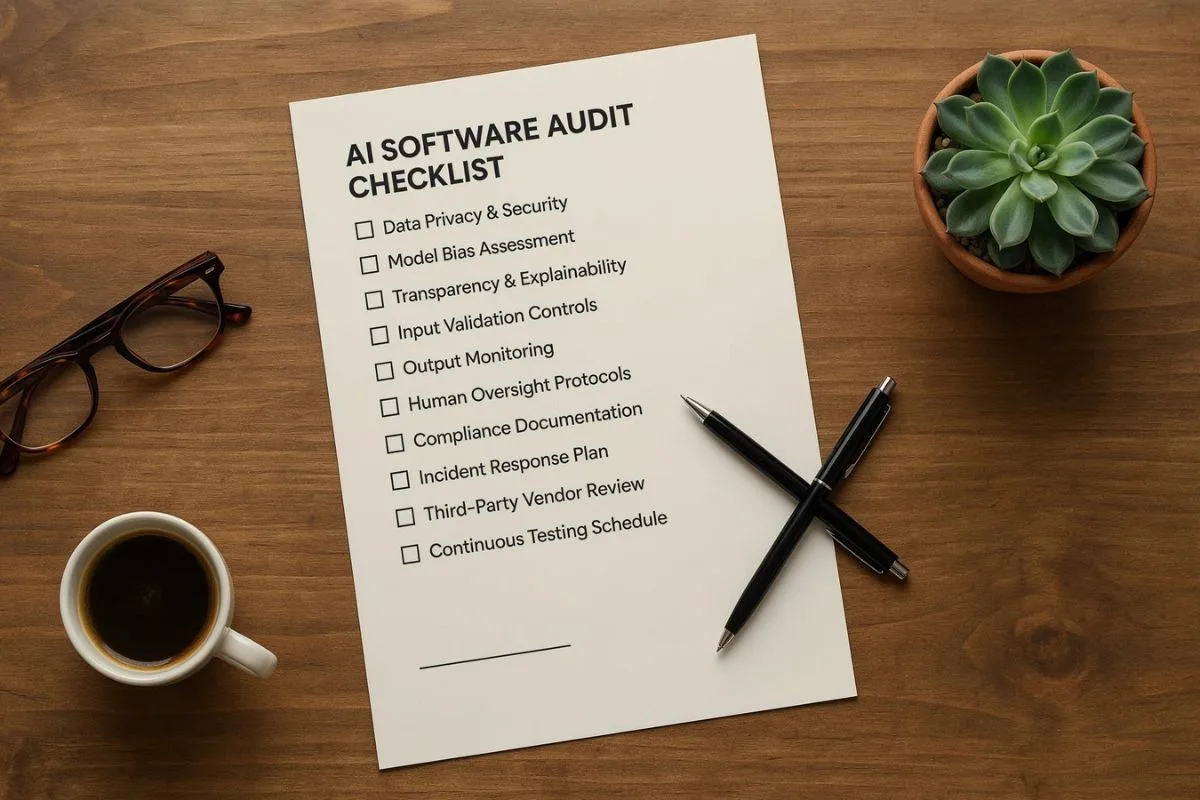
AI-Software-Audit-Checklist.webp

Artificial intelligence (AI) and machine learning are becoming increasingly important across pharmaceutical research, manufacturing, quality, clinical, and regulatory processes. However, using AI in a regulated environment creates new compliance considerations around data, software validation, model performance, human oversight, security, and change management.

A structured AI software audit checklist helps pharmaceutical companies evaluate whether an AI application is suitable for its intended use and whether appropriate controls are in place throughout its lifecycle.

For GxP environments, an AI audit should go beyond checking whether the software works. Auditors should also examine how the system was developed, validated, monitored, changed, documented, and controlled.

Also read: AI Software Compliance Audits in Pharma: Complete 2026 Guide

What Is an AI Software Audit?

An AI software audit is a systematic review of an artificial intelligence or machine learning application to determine whether it meets defined quality, compliance, security, and performance expectations.

In pharmaceutical environments, the audit may consider:

  • Intended use and context of use
  • GxP impact and risk classification
  • Data governance and data integrity
  • AI model development and validation
  • Software lifecycle controls
  • Human oversight
  • Audit trails and access controls
  • Cybersecurity
  • Change management
  • Vendor controls
  • Regulatory and quality requirements

FDA’s current risk-based software assurance guidance specifically includes artificial intelligence and machine learning tools among technologies that can be considered within a risk-based assurance framework when used in production or quality management systems.

AI Software Audit Checklist for Pharmaceutical Companies

The following checklist can help auditors and pharmaceutical organizations review important areas of an AI application.

1. AI System Inventory and Risk Assessment

The first step is identifying all AI and machine learning applications used within the organization.

Check whether:

  • All AI systems are listed in an approved inventory.
  • The intended use of each AI application is documented.
  • The context of use is clearly defined.
  • Each system has undergone a documented risk assessment.
  • GxP impact has been evaluated.
  • Critical or high-risk applications receive appropriate controls.
  • System ownership and accountability are clearly assigned.
  • Risk assessments are periodically reviewed and updated.

A risk-based approach is particularly important because not every AI application has the same impact on product quality, patient safety, data integrity, or regulatory decisions.

2. AI Governance and Oversight

Effective AI governance establishes who is responsible for approving, monitoring, and controlling AI systems.

An audit should determine whether:

  • A documented AI governance framework exists.
  • Roles and responsibilities are defined.
  • AI system owners have been assigned.
  • Quality and regulatory functions are involved where required.
  • AI use is subject to appropriate approval procedures.
  • Model changes are controlled.
  • AI performance is periodically reviewed.
  • Escalation procedures exist for unexpected results.
  • Governance requirements are applied throughout the AI lifecycle.

FDA and EMA’s joint principles for good AI practice in drug development emphasize human-centric design, risk-based approaches, clear context of use, multidisciplinary expertise, data governance, model development, performance assessment, and lifecycle management.

3. Training Data Quality and Governance

AI performance depends heavily on the quality and suitability of its data.

The AI software audit checklist should therefore examine:

  • Whether training data comes from reliable sources.
  • Whether data is appropriate for the intended use.
  • Whether data sources are documented.
  • Whether data completeness has been evaluated.
  • Whether preprocessing activities are documented.
  • Whether data quality checks are performed.
  • Whether potential bias has been assessed.
  • Whether data changes are controlled.
  • Whether data lineage can be demonstrated.
  • Whether data retention requirements are defined.

For GxP systems, organizations should also consider whether data remains attributable, legible, contemporaneous, original, and accurate. EMA identifies ALCOA principles as a key part of pharmaceutical data integrity expectations.

4. AI Model Development and Validation

AI models should be developed and evaluated using a controlled and documented process.

Auditors should check:

  • Whether model requirements are documented.
  • Whether the development methodology is defined.
  • Whether acceptance criteria are established.
  • Whether appropriate performance metrics are selected.
  • Whether independent test data is used.
  • Whether validation activities are documented.
  • Whether model limitations are identified.
  • Whether expected performance ranges are established.
  • Whether model performance is monitored after deployment.
  • Whether deviations from expected performance are investigated.

The depth of assurance should reflect the AI application’s intended use and risk.

5. AI Model Documentation

Complete documentation is essential for demonstrating that an AI system is controlled and suitable for its intended purpose.

Review whether documentation includes:

  • Intended use and context of use
  • Model architecture
  • Input and output specifications
  • Training data information
  • Data preprocessing methods
  • Model assumptions
  • Known limitations
  • Performance criteria
  • Validation results
  • Version history
  • Change history
  • Approval records
  • Monitoring requirements

Clear documentation also helps auditors understand how an AI system reaches or supports a particular outcome.

6. Human Oversight and Intervention

AI should not automatically replace appropriate human responsibility in regulated processes.

An audit should assess whether:

  • Human review of AI outputs is defined.
  • Personnel understand when intervention is required.
  • Users can override AI recommendations where appropriate.
  • Human interventions are documented.
  • Escalation procedures are established.
  • AI limitations are communicated to users.
  • Personnel receive appropriate training.
  • Critical decisions have suitable human oversight.

Human-centric design is one of the principles highlighted by FDA and EMA for responsible AI use in drug development.

7. Data Integrity and Audit Trails

Data integrity is a critical part of an AI audit pharma assessment because AI applications may process large volumes of data and generate outputs that influence regulated activities.

Auditors should verify:

  • Audit trails are enabled where required.
  • User access is controlled.
  • AI inputs and outputs can be traced.
  • Data changes are recorded.
  • Model changes are documented.
  • Critical records are protected from unauthorized modification.
  • Electronic records are appropriately controlled.
  • Data remains accurate and reliable throughout its lifecycle.

FDA’s GMP guidance also emphasizes validation and controls over computerized systems, including controls against unauthorized access or data changes.

8. AI Software Security

Security risks should be included in the pharmaceutical AI audit.

The review may cover:

  • User authentication
  • Role-based access
  • Privileged access management
  • Data encryption
  • Secure interfaces
  • Protection against unauthorized model changes
  • Protection against malicious inputs
  • Data poisoning risks
  • Model theft risks
  • Security monitoring
  • Incident response
  • Security documentation

Security controls should be appropriate to the AI application’s risk, data sensitivity, and intended use.

9. Regulatory and GxP Compliance

AI systems used in regulated processes should be evaluated against applicable regulatory and quality requirements.

Depending on the system and its intended use, an audit may review:

  • GxP requirements
  • Data integrity expectations
  • Computerized system validation or assurance
  • 21 CFR Part 11 where applicable
  • EU GMP Annex 11 where applicable
  • Internal quality procedures
  • Electronic record controls
  • Change control
  • Deviation management
  • CAPA requirements
  • Applicable FDA and EMA expectations

Importantly, regulatory requirements should be assessed according to the actual intended use of the AI system rather than assuming that every AI application requires the same level of validation.

FDA’s 2026 Computer Software Assurance guidance supports a risk-based approach to determining appropriate assurance activities and specifically recognizes AI/ML tools within its examples.

10. AI Vendor and Supplier Management

Many pharmaceutical organizations use third-party AI platforms, cloud services, models, or software providers. These suppliers should therefore be included in the audit strategy.

Check whether:

  • The AI vendor has been appropriately qualified.
  • Supplier risk has been assessed.
  • A quality agreement exists where required.
  • Vendor responsibilities are documented.
  • Validation or assurance documentation is available.
  • Software updates are communicated.
  • AI model changes are controlled.
  • Vendor performance is periodically reviewed.
  • Supplier audits are performed when justified by risk.
  • Business continuity and contingency plans exist.

Third-party AI should not be treated as outside the organization’s quality responsibility simply because the underlying technology is supplied by another company.

11. AI Change Management and Lifecycle Control

AI systems can change over time because of software updates, model retraining, new datasets, configuration changes, or modifications to algorithms.

An audit should therefore verify:

  • AI changes are formally documented.
  • Change requests are risk assessed.
  • Model updates are reviewed before implementation.
  • Validation or testing is performed when required.
  • Approval is documented.
  • Previous versions can be identified.
  • Retraining activities are controlled.
  • Post-change performance is evaluated.
  • Unexpected changes are investigated.

Lifecycle management is an important part of current AI governance principles, particularly where AI systems may evolve after initial implementation.

12. AI Performance Monitoring

An AI system should continue to perform as expected after deployment.

Organizations should define appropriate monitoring for:

  • Accuracy
  • Reliability
  • Model performance
  • Data quality
  • Unexpected outputs
  • Drift
  • Bias
  • Error rates
  • User feedback
  • Critical incidents
  • Performance against acceptance criteria

Where an AI system is used for a regulated activity, predefined actions should exist for performance deterioration or unexpected behavior.

Common Findings During AI Software Audits

Some common findings may include:

  • Incomplete AI system inventories
  • Missing or unclear intended-use documentation
  • Weak AI governance
  • Poor training data documentation
  • Inadequate data lineage
  • Insufficient model validation
  • Missing model limitations
  • Weak change control
  • Inadequate human oversight
  • Poor audit trail controls
  • Incomplete vendor qualification
  • Insufficient cybersecurity controls
  • Lack of ongoing performance monitoring

Identifying these issues early can help organizations address compliance gaps before they become larger quality or regulatory concerns.

How to Prepare for an AI Software Audit

Pharmaceutical companies can improve audit readiness by taking a structured approach.

Before an audit:

  1. Identify all AI applications.
  2. Document intended use and context of use.
  3. Complete a risk assessment.
  4. Review data governance and integrity controls.
  5. Verify validation and assurance documentation.
  6. Review model development records.
  7. Check change-control history.
  8. Assess human oversight.
  9. Review cybersecurity controls.
  10. Evaluate AI vendors.
  11. Review performance monitoring.
  12. Track and close identified CAPA actions.

A pre-audit assessment can help identify missing documentation and control weaknesses before a formal audit or regulatory inspection.

How GxP Cellators Supports AI Software Audits

GxP Cellators provides AI software auditing services for pharmaceutical and other regulated organizations seeking to evaluate the compliance, quality, and control of AI applications.

Its AI audit support can include:

  • AI software compliance audits
  • Pre-audit readiness assessments
  • AI governance reviews
  • AI risk assessments
  • Training data quality reviews
  • Data integrity assessments
  • AI model validation documentation reviews
  • Human oversight assessments
  • AI cybersecurity assessments
  • Regulatory compliance reviews
  • Vendor and supplier audits
  • Mock audit support
  • CAPA review and follow-up

GxP Cellators applies a risk-based approach to help organizations identify practical gaps and develop actionable improvement plans.

Why Choose GxP Cellators for AI Software Auditing?

GxP Cellators combines GxP compliance knowledge with an understanding of emerging AI technologies to support organizations implementing AI in regulated environments.

The approach focuses on:

  • Risk-based audit planning
  • GxP and quality considerations
  • Data integrity
  • AI governance
  • Software assurance and validation
  • Regulatory expectations
  • Practical audit findings
  • Corrective and preventive actions
  • Confidential handling of client information

The objective is not simply to identify problems but to help organizations understand the compliance risk and prioritize appropriate corrective actions.

Frequently Asked Questions

What should be included in an AI software audit checklist?

An AI software audit checklist should cover system inventory, intended use, risk assessment, governance, data quality, model development, validation, documentation, human oversight, data integrity, cybersecurity, regulatory compliance, change management, performance monitoring, and vendor management.

How often should AI software audits be conducted?

There is no single audit frequency for every AI application. The appropriate frequency should be based on factors such as GxP impact, system criticality, risk, changes to the model or software, vendor risk, and previous audit findings. Higher-risk applications may require more frequent review.

Who should conduct an AI software audit?

AI software audits should be performed by professionals who understand both AI technologies and regulated environments. Auditors should have knowledge of GxP requirements, software validation or assurance, data integrity, risk management, and AI lifecycle controls.

What are common findings in AI software audits?

Common findings can include incomplete system inventories, unclear intended use, inadequate governance, weak training data documentation, insufficient model validation, missing change controls, inadequate human oversight, weak data integrity controls, and incomplete vendor management.

Is AI software validation required in pharmaceutical environments?

The appropriate level of validation or software assurance depends on the intended use and risk of the system. GMP-related computerized systems require appropriate controls and validation, with the depth and scope depending on factors such as application complexity and criticality.

How does GxP Cellators support AI software audits?

GxP Cellators provides AI software auditing services covering risk assessment, governance, data integrity, model documentation, validation review, human oversight, cybersecurity, regulatory compliance, vendor assessment, mock audits, and CAPA follow-up.

How can I contact GxP Cellators for AI software audit support?

Organizations looking for AI software audit support can contact GxP Cellators to discuss their AI application, intended use, GxP requirements, and audit objectives.

 Also read: How to Prepare for an AI Application Validation Audit in GxP

Contact GxP Cellators

If your pharmaceutical organization is implementing AI or already using AI in a GxP environment, a structured audit can help identify compliance risks and strengthen controls.

Contact GxP Cellators for AI software auditing support and discuss your requirements with the team.


07/10/2026
AI-software-compliance-audits-in-pharma-1280x720.webp

Artificial intelligence is becoming an important part of the pharmaceutical industry. Companies are using AI applications for drug discovery, manufacturing, quality operations, pharmacovigilance, data analysis, and other GxP-related activities. These technologies can improve efficiency, but they also introduce new compliance responsibilities.

AI software used within regulated pharmaceutical environments must be appropriately controlled, validated, documented, and monitored. Organizations also need to address data integrity, cybersecurity, human oversight, change management, and vendor risks.

This guide explains the key aspects of AI software compliance audits in pharma for 2026 and how GxP Cellators can help organizations evaluate the compliance of their AI applications.

What Is AI Software Compliance?

AI software compliance refers to ensuring that artificial intelligence applications used in GxP-regulated activities satisfy relevant regulatory and quality requirements.

Important compliance areas include:

  • Computerized system validation under requirements such as 21 CFR Part 11 and EU GMP Annex 11
  • Data integrity and ALCOA+ principles
  • Change control and AI model version management
  • User access controls and audit trails
  • Documentation and electronic records
  • Human oversight and accountability
  • AI vendor and supplier qualification
  • Risk management and ongoing monitoring

A compliance audit helps determine whether these controls are properly implemented and whether the AI application remains suitable for its intended GxP use.

The AI Software Compliance Audit Process

Phase 1: Audit Planning

The first stage establishes the scope, objectives, and approach of the audit.

Typical activities include:

  • Defining the audit scope and objectives
  • Identifying AI applications that require assessment
  • Determining applicable regulations and standards
  • Reviewing existing policies and documentation
  • Preparing an audit plan and compliance checklist

Phase 2: Audit Execution

During execution, auditors evaluate the AI application and supporting processes against defined requirements.

Activities may include:

  • Conducting an opening meeting
  • Reviewing relevant documentation and records
  • Interviewing responsible personnel
  • Performing system walkthroughs
  • Testing controls and reviewing supporting evidence
  • Identifying and documenting compliance findings

Phase 3: Audit Reporting

After completing the assessment, findings are evaluated and formally reported.

This stage generally involves:

  • Classifying findings according to risk
  • Preparing the audit report
  • Conducting a closing or close-out meeting
  • Agreeing on corrective actions
  • Establishing CAPA implementation timelines

Phase 4: Follow-Up

An audit is not complete simply because the report has been issued. Follow-up activities help confirm that identified issues have been effectively addressed.

Follow-up may include:

  • Reviewing CAPA plans
  • Verifying corrective action implementation
  • Evaluating CAPA effectiveness
  • Confirming that findings have been adequately resolved
  • Formally closing audit observations

Key Areas of AI Software Compliance Audits

Audit AreaKey Questions
AI System InventoryHave all AI applications been identified, documented, and risk assessed?
AI GovernanceIs there a defined governance framework for AI use?
Training DataAre training datasets properly controlled, documented, and governed?
Model DevelopmentIs the AI model development process documented and appropriately validated?
Model DocumentationAre the model architecture, intended use, limitations, and assumptions documented?
Human OversightAre appropriate processes established for reviewing AI-generated outputs?
Data IntegrityAre access controls, audit trails, and data integrity controls effective?
SecurityIs the AI application protected against relevant cybersecurity and system-specific risks?
Regulatory ComplianceDoes the application meet applicable requirements such as 21 CFR Part 11 and EU GMP Annex 11?
Vendor ManagementHave AI software providers and vendors been appropriately qualified and assessed?

How GxP Cellators Supports AI Software Compliance Audits

GxP Cellators provides specialized AI software compliance audit services for pharmaceutical and GxP-regulated organizations. Its audit approach considers both the regulatory expectations applicable to GxP systems and the specific risks associated with artificial intelligence technologies.

AI Software Compliance Audit Services Include:

  • Full-scope AI software compliance audits
  • Pre-audit readiness assessments
  • AI governance framework assessments
  • Training data quality and governance audits
  • AI model validation documentation reviews
  • Human oversight process assessments
  • Data integrity audits for AI applications
  • AI security assessments
  • Regulatory compliance reviews
  • Vendor and supplier audits for AI applications
  • Mock AI audits for inspection preparation
  • CAPA verification and follow-up audits

These assessments can help organizations identify compliance weaknesses before they become significant regulatory or operational concerns.

Why Choose GxP Cellators for AI Software Compliance Audits?

Organizations working with AI in regulated environments need auditors who understand both GxP compliance and AI technology. GxP Cellators provides an integrated approach to help businesses assess their AI applications against applicable quality and regulatory expectations.

Key benefits include:

  • Auditors experienced in GxP requirements and AI technologies
  • Coverage of FDA, EMA, Health Canada, MHRA, and WHO expectations
  • Risk-based audit approaches tailored to individual AI applications
  • Practical and actionable audit reports
  • Support for identifying and remediating compliance gaps
  • Confidential handling of proprietary systems and information

Frequently Asked Questions

Q1: What is AI software compliance in pharma?

AI software compliance in pharma means ensuring that artificial intelligence applications used in GxP activities meet applicable requirements for validation, data integrity, documentation, human oversight, security, and vendor management.

Q2: Which regulations apply to AI software in pharma?

Depending on the intended use and jurisdiction, relevant requirements may include 21 CFR Part 11 for electronic records and signatures and EU GMP Annex 11 for computerized systems. Data integrity expectations based on ALCOA+ principles are also important. GAMP 5 can provide a risk-based framework for computerized system validation.

Q3: How often should AI software compliance audits be conducted?

Audit frequency should be determined according to the risk associated with the AI application. High-risk AI systems may require more frequent assessments, potentially annually, while lower-risk applications may follow longer audit intervals. Significant system changes, incidents, or regulatory developments can also trigger an audit.

Q4: What are common findings in AI software compliance audits?

Common findings can include incomplete AI system inventories, weak governance frameworks, insufficient training data documentation, inadequate model validation records, weak change control, incomplete data integrity controls, and insufficient human oversight of AI-generated outputs.

Q5: How does GxP Cellators support AI software compliance audits?

GxP Cellators supports organizations through full-scope AI software compliance audits, pre-audit readiness assessments, AI governance reviews, training data assessments, model validation documentation reviews, data integrity assessments, vendor audits, and mock inspection activities.

Q6: How do I contact GxP Cellators for AI software compliance audit support?

Organizations seeking support with AI software compliance audits can contact GxP Cellators to discuss their requirements, AI applications, audit scope, and compliance objectives.

Contact GxP Cellators

If your organization uses AI applications within pharmaceutical or other GxP-regulated activities and requires compliance assessment, GxP Cellators can provide specialized audit support.

Contact GxP Cellators: https://www.gxpcellators.com/contact/


07/10/2026
P94oJSx-sI0Nbmt-50f3M-1280x720.webp

Preparing for an AI application validation audit in a GxP environment requires proper planning, strong documentation, effective governance, and a clear understanding of audit expectations. AI-based applications have characteristics that can make their validation different from traditional computerized systems.

Auditors may review areas such as AI model development, training data, intended use, risk management, human oversight, change control, and system performance. Therefore, organizations should begin their preparation well before the actual audit.

This guide explains how to prepare for an AI application validation audit and how GxP Cellators can support organizations with AI audit preparation and readiness activities.

Step 1: Understand Your AI Systems

The first step in preparing for an AI validation audit is to establish a clear understanding of all AI applications used within your organization.

You should:

  • Create or update an inventory of AI systems.
  • Define the intended use of every AI application.
  • Identify the GxP processes and activities supported by each system.
  • Determine the risk level associated with every AI application.
  • Document the type of AI or machine learning model being used.
  • Record information about how the model was developed and trained.
  • Explain how the AI system generates and delivers outputs.
  • Document human review and oversight mechanisms.

Having this information clearly documented allows your organization to demonstrate control over its AI applications during an audit.

Step 2: Review and Update Your Documentation

Documentation is one of the most important areas auditors examine. Before the audit, review all relevant records to ensure they are complete, accurate, current, and consistent with actual system practices.

Important documents may include:

  • System Requirements Specifications
  • AI validation plans and reports
  • Model development documentation
  • Training data documentation
  • AI risk assessments
  • Standard Operating Procedures
  • User manuals and training records
  • Change control documentation
  • Audit trail records
  • User access and security records

Any missing, outdated, or inconsistent documentation should be identified and corrected before the audit.

Step 3: Evaluate Your AI Governance Framework

Effective AI governance helps organizations maintain control over AI applications throughout their lifecycle. During audit preparation, review whether your governance framework clearly defines how AI systems are managed, monitored, changed, and approved.

Consider the following questions:

  • Is there a documented AI governance framework?
  • Are roles and responsibilities clearly assigned?
  • Is there an AI oversight committee or equivalent governance structure?
  • Are AI applications covered by appropriate GxP change control procedures?
  • Is there a formal process for reviewing and approving AI model updates?
  • Are AI-related risks included in the organization’s quality risk management process?
  • Are responsibilities for monitoring AI performance clearly defined?

Strong governance demonstrates that AI is being managed as a controlled GxP system rather than simply as a technology tool.

Step 4: Prepare Your Team

An AI validation audit does not only evaluate systems and documentation. Auditors may also interview personnel responsible for developing, validating, operating, or overseeing AI applications.

Prepare your team by:

  • Training employees on AI validation requirements.
  • Ensuring personnel understand their responsibilities for AI oversight.
  • Preparing employees for potential auditor interviews.
  • Conducting internal mock audits.
  • Practicing explanations of AI model development and validation.
  • Ensuring employees understand relevant procedures and controls.

Mock interviews can help identify knowledge gaps and improve the team’s confidence before the actual audit.

Step 5: Conduct a Pre-Audit Gap Assessment

A pre-audit gap assessment can help identify weaknesses before they become audit findings. It provides an opportunity to compare your existing AI systems, documentation, governance, and controls against applicable audit expectations.

During the assessment, you should:

  • Review AI systems against an appropriate audit checklist.
  • Identify gaps in documentation and validation.
  • Evaluate AI governance and oversight controls.
  • Review risk management processes.
  • Identify weaknesses in access controls, audit trails, or change control.
  • Develop corrective and preventive action plans.
  • Complete necessary corrections before the audit.

Addressing identified gaps early can significantly improve AI validation readiness.

How GxP Cellators Helps You Prepare for an AI Validation Audit

GxP Cellators provides AI audit preparation and validation support for organizations operating in regulated GxP environments. Our team can help identify compliance gaps, review documentation, assess governance practices, and prepare personnel for potential audit questions.

Our AI Audit Preparation Services Include:

  • Pre-audit gap assessments for AI applications
  • AI governance framework reviews
  • Documentation reviews and gap analysis
  • Mock AI validation audits
  • Training on AI validation and audit expectations
  • CAPA plan development and implementation support

These services are designed to provide practical recommendations that organizations can implement before an audit or inspection.

Why Choose GxP Cellators?

GxP Cellators supports organizations with a risk-based approach to AI validation and GxP compliance.

Key advantages include:

  • Professionals with experience in GxP and AI technologies
  • Consideration of FDA, EMA, Health Canada, MHRA, and WHO expectations
  • Risk-based assessment tailored to individual AI applications
  • Practical and actionable audit preparation recommendations
  • Confidential handling of proprietary AI systems and information

This approach helps organizations identify potential weaknesses and improve their overall AI audit readiness.

Frequently Asked Questions

Q1: How far in advance should I prepare for an AI validation audit?

AI audit preparation should begin as early as possible, preferably several months before a planned audit or inspection. Starting early provides sufficient time to identify gaps, update documentation, strengthen controls, and implement corrective actions.

Q2: What documents should I have ready for an AI validation audit?

Important documents may include the AI system inventory, intended-use documentation, risk assessments, validation plans and reports, model development records, training data documentation, SOPs, training records, and change control documentation.

Q3: How can I prepare my team for an AI validation audit?

Train employees on AI validation requirements and their specific responsibilities. You can also conduct mock audits, prepare employees for auditor interviews, and practice explaining AI model development, validation, monitoring, and oversight processes.

Q4: What is a pre-audit gap assessment?

A pre-audit gap assessment evaluates AI systems, documentation, governance, and controls against applicable audit requirements. It helps identify weaknesses early so corrective actions can be completed before the actual audit.

Q5: How does GxP Cellators help with AI audit preparation?

GxP Cellators supports AI audit preparation through pre-audit gap assessments, AI governance reviews, documentation assessments, mock audits, validation training, and CAPA development support.

Q6: How do I contact GxP Cellators for AI audit preparation support?

You can contact GxP Cellators through the official contact page to discuss your AI validation audit preparation requirements and understand how the team can support your organization.

Contact GxP Cellators

If your organization needs professional support to prepare for an AI application validation audit in a GxP environment, GxP Cellators can help with audit readiness, gap assessment, documentation review, governance evaluation, and validation preparation.

Contact GxP Cellators: https://www.gxpcellators.com/contact/


07/10/2026
AI-Validation-vs-Traditional-CSV-1280x720.webp

Computer System Validation (CSV) has been an important part of GxP compliance for many years. Traditional CSV follows a structured approach that includes defining requirements, designing the system, testing it against approved requirements, documenting results, and maintaining the validated state throughout the system lifecycle.

However, artificial intelligence systems introduce new challenges that do not always fit into the traditional CSV model. AI applications may change their behavior based on training data, model updates, or ongoing learning.

This makes AI validation vs traditional CSV an important consideration for organizations using AI in regulated GxP environments. GxP auditors need to understand these differences when assessing AI applications.

GxP Cellators supports organizations with both traditional CSV audits and AI validation audits, helping them identify compliance risks and strengthen their validation controls.

Key Differences Between AI Validation and Traditional CSV

1. Determinism

Traditional computerized systems are generally deterministic. When the same input is provided under the same conditions, the system is expected to produce the same output. This makes it easier for auditors to verify system behavior through predefined validation tests.

AI systems can behave differently. Depending on the model, training data, configuration, or context, the same input may sometimes produce different results.

Therefore, AI validation needs to consider variability and may require additional testing methods to evaluate model performance.

2. Learning and Adaptation

Traditional systems normally do not change their behavior unless an authorized system change is implemented through a formal change control process.

Some AI applications, however, may learn from new information or be updated regularly. This can potentially affect their behavior over time.

GxP organizations therefore need controls that identify when an AI model changes and determine whether additional validation is required.

3. Transparency

Traditional software is generally easier to trace. Requirements can be linked to system design, functionality, code, and testing activities.

Many AI models can be more difficult to interpret. The reasoning behind a particular output may not always be easy to explain.

For this reason, AI validation documentation should address model transparency and explainability where applicable, particularly when AI outputs can affect GxP processes or decisions.

4. Data Dependency

Traditional computerized systems rely on data inputs, but their core logic is primarily defined through programmed rules and code.

AI systems can be highly dependent on training data. The quality, completeness, accuracy, and representativeness of that data can directly influence model behavior.

AI validation therefore needs to consider training data quality, data governance, data integrity, and the suitability of datasets used during model development.

5. Performance Monitoring

Traditional systems are commonly monitored for errors, failures, incidents, and deviations.

AI systems require an additional focus on ongoing performance. Model accuracy or effectiveness can change over time because of changing data, environments, or operational conditions.

Continuous or periodic monitoring should therefore be considered as part of the AI validation lifecycle.

Validation Approach Comparison

AspectTraditional CSVAI Validation
DeterminismGenerally deterministic outputsNon-deterministic outputs may occur
LearningNo learning after release unless changedSome systems may learn or adapt
TransparencyGenerally easier to understandModels may be difficult to interpret
Data DependencyLogic mainly defined by codeBehavior strongly influenced by training data
Performance MonitoringFocus on failures and deviationsRequires ongoing model performance monitoring
Change ControlFormal change control processMay require continuous or enhanced monitoring
DocumentationRequirements, design, testing, and resultsModel development, training data, testing, and validation
Human OversightUser training and operational proceduresHuman review and intervention may be required

What GxP Auditors Should Check

When auditing AI applications, GxP auditors should look beyond the areas traditionally reviewed during CSV audits.

Important areas may include:

  • AI system inventory and risk assessment
  • AI governance and management oversight
  • Training data quality and governance
  • Model development and validation documentation
  • Model version control
  • AI model change management
  • Human oversight and intervention procedures
  • Data integrity controls
  • AI-specific cybersecurity controls
  • Regulatory and GxP compliance
  • Vendor and supplier controls for AI applications
  • Ongoing AI performance monitoring
  • Documentation of model testing and validation decisions

These controls help organizations demonstrate that AI applications remain suitable for their intended GxP use.

How GxP Cellators Supports CSV and AI Validation Audits

GxP Cellators provides auditing support for both traditional computerized systems and emerging AI technologies used in regulated environments.

Our auditors understand that AI applications can introduce validation challenges that are different from conventional software. We help organizations assess these risks and determine whether appropriate controls, documentation, testing, and oversight are in place.

Our CSV and AI Audit Services Include:

  • Traditional CSV audits for GxP computerized systems
  • AI application validation audits
  • CSV support for emerging technologies
  • 21 CFR Part 11 compliance audits
  • EU GMP Annex 11 compliance audits
  • Data integrity audits
  • Vendor and supplier audits
  • Mock inspections for CSV and AI systems

Why Choose GxP Cellators?

GxP Cellators supports organizations with a practical and risk-based approach to computerized system and AI auditing.

Key advantages include:

  • Experienced auditors familiar with CSV and AI technologies
  • Coverage of FDA, EMA, Health Canada, MHRA, and WHO expectations
  • Risk-based audit approaches tailored to individual systems
  • Practical and actionable audit reports
  • Confidential handling of proprietary information
  • Support for both traditional computerized systems and emerging AI applications

Frequently Asked Questions

Q1: Can traditional CSV methods be applied to AI systems?

Traditional CSV principles can provide a foundation for AI validation, but they may not be sufficient on their own. AI systems can require additional controls and validation activities to address factors such as non-deterministic behavior, model changes, data dependency, explainability, and ongoing performance.

Q2: What is the biggest difference between CSV and AI validation?

One of the major differences is determinism. Traditional computerized systems are generally expected to produce consistent results when the same input and conditions are used. AI systems may produce different outputs depending on model configuration, data, and context. This can require additional testing and performance monitoring.

Q3: Do AI systems need to comply with 21 CFR Part 11?

When AI systems are used in GxP environments and create, modify, maintain, or use electronic records or electronic signatures within the scope of the regulation, applicable 21 CFR Part 11 controls need to be considered. Relevant computerized system requirements, including EU GMP Annex 11 where applicable, should also be assessed.

Q4: How does GxP Cellators support CSV and AI validation?

GxP Cellators provides auditing services for traditional CSV systems as well as AI applications. Its auditors assess system risks, validation controls, data integrity, governance, documentation, and other relevant compliance areas to help organizations identify gaps and strengthen their controls.

Q5: How can I contact GxP Cellators for CSV or AI validation support?

Organizations looking for CSV or AI validation audit support can contact GxP Cellators through its contact page to discuss their requirements and compliance needs.

Contact GxP Cellators

If your organization needs support with CSV audits, AI validation audits, data integrity, or GxP computerized system compliance, GxP Cellators can help assess your requirements and identify potential compliance gaps.

Contact GxP Cellators: https://www.gxpcellators.com/contact/


Our Presence


Saskatchewan, Canada

Calgary, Canada

Toronto, Canada

North Carolina, USA

Frankfurt, Germany


Indiana, USA

Get in Touch


+1 (306) 715 -9460


Saskatchewan, Canada

https://www.gxpcellators.com


You cannot copy content of this page

Verified by MonsterInsights